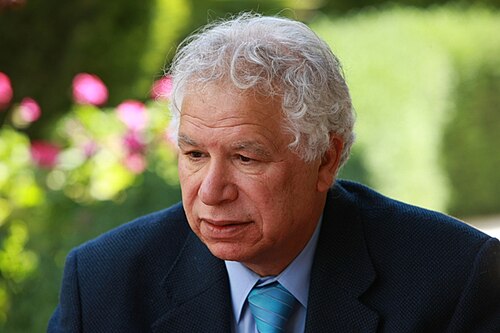
Mourid Barghouti
مريد البرغوثي
Born: Deir Ghassana, Mandatory Palestine
Domain: Literature & Poetry
Recognition: Regionally recognized
Member of the Palestinian diaspora
Biography
Mourid Barghouti was a Palestinian poet and memoirist whose work gave one of the most refined literary expressions to the experience of exile and return. Born in 1944 in the village of Deir Ghassana near Ramallah, he studied English literature at Cairo University, graduating in June 1967, the very month of the war that would close his homeland to him and turn him into one of the countless "displaced" Palestinians barred from returning for three decades. His years of exile took him through Cairo, Beirut, Budapest, Baghdad, and Amman, including a period when he was expelled from Egypt and separated from his wife, the prominent Egyptian novelist Radwa Ashour, and their young son. Out of this restless, fragmented life he forged a substantial body of poetry, eventually publishing some twelve collections marked by precision, understatement, and a deep meditation on dispossession. Barghouti's most celebrated achievement is his prose memoir "I Saw Ramallah" (1997), written after the Oslo Accords finally allowed him to return to his hometown after thirty years away. The book's clear-eyed, unsentimental reckoning with exile, memory, and the strangeness of homecoming won the Naguib Mahfouz Medal for Literature and was hailed by Edward Said as one of the finest existential accounts of Palestinian displacement. A sequel, "I Was Born There, I Was Born Here," continued the meditation. Throughout his career he was admired for the quiet intensity of his style, which avoided slogan and rhetoric in favor of exact observation and emotional restraint, offering an alternative model of how Palestinian experience could be rendered in literature. His readings drew devoted audiences across the Arab world. Barghouti died in Amman in 2021. He is remembered as a major poet and as the author of a memoir that became a modern classic of exile literature, read far beyond the Arab world in many translations. His writing, together with that of his son the poet Tamim al-Barghouti, has helped carry the Palestinian literary voice into the twenty-first century.
Why This Person Matters
Barghouti wrote "I Saw Ramallah," a modern classic of exile literature, and gave the Palestinian experience of displacement an unmatched poetic restraint.
Historical Context
Born in 1944 in the village of Deir Ghassana near Ramallah, Mourid Barghouti graduated in English from Cairo University in June 1967, the very month the war closed his homeland to him and made him one of the countless displaced Palestinians barred from return for thirty years. His exile carried him through Cairo, Beirut, Budapest, Baghdad, and Amman, including expulsion from Egypt and painful separation from his wife, the novelist Radwa Ashour, and their son. The Oslo Accords finally permitted his return to Ramallah, the homecoming that produced his most celebrated book. His life mapped the long arc of Palestinian exile from 1967 to Oslo.
Historical Context
- — Born in Deir Ghassana, Mandatory Palestine
- — The Nakba – Palestinian catastrophe and mass displacement
- — Six-Day War and occupation of West Bank and Gaza
- — Passed away at age 76
Selected Works
- I Saw Ramallah — A memoir of the poet's return to his Palestinian hometown after thirty years of exile, tracing what occupation does to time, memory, and the body. Edward Said called it 'one of the best books about the Palestinian condition ever written.'
Legacy & Influence
Barghouti published some twelve poetry collections marked by precision and understatement, but his most enduring work is the 1997 prose memoir 'I Saw Ramallah,' written after his thirty-year exile ended; it won the Naguib Mahfouz Medal and was hailed by Edward Said as one of the finest existential accounts of Palestinian displacement, with a sequel, 'I Was Born There, I Was Born Here.' His quiet, slogan-free style offered an alternative model of rendering Palestinian experience. He died in Amman in 2021, remembered as a major poet whose memoir became a modern classic of exile, carried with his son Tamim's poetry into the twenty-first century.
Topics & Themes
- British Mandate
- Diaspora
References & Sources
- Mourid Barghouti — https://en.wikipedia.org/wiki/Mourid_Barghouti
- Mourid Barghouti's I Saw Ramallah | Al Jadid — https://aljadid.com/content/mourid-barghouti%E2%80%99s-i-saw-ramallah
- Mourid Barghouti | Arab World Books — https://www.arabworldbooks.com/en/authors/mourid-barghouti