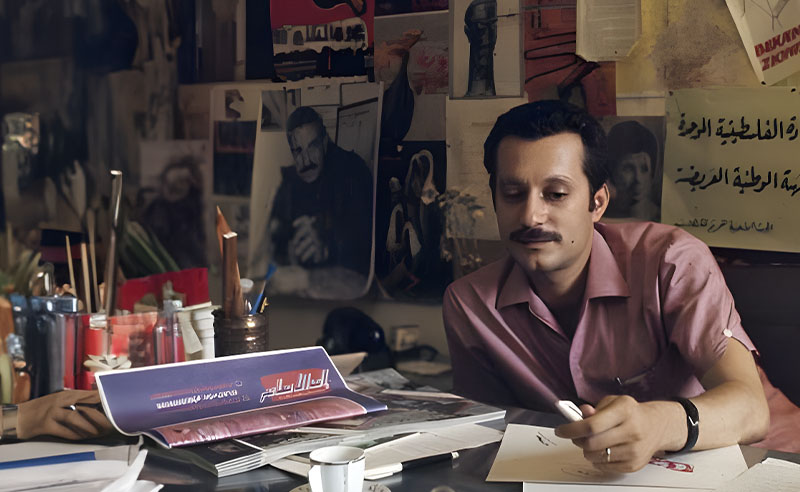
Ghassan Kanafani
غسان كنفاني
Born: Acre, Mandatory Palestine
Domain: Literature & Poetry
Recognition: Globally recognized
Member of the Palestinian diaspora
Biography
Ghassan Kanafani was a Palestinian novelist, short-story writer, journalist, and political activist whose fiction defined the literature of the Palestinian dispossession. Born in Acre in 1936, he was twelve years old when the 1948 war drove his family into exile, first to Lebanon and then to Damascus, where he completed his schooling and began working as a teacher and journalist. The experience of becoming a refugee shaped both his art and his politics for the rest of his short life. Kanafani's 1962 novella "Men in the Sun" is one of the landmarks of modern Arabic fiction. It follows three Palestinian refugees who attempt to be smuggled across the desert into Kuwait inside the empty water tank of a lorry, only to suffocate as the driver is delayed at a border checkpoint. Its devastating final image and its implicit indictment of Arab passivity made it a touchstone of Palestinian and Arab self-criticism, later adapted into the celebrated film "The Dupes." He continued to produce powerful works including "All That's Left to You," "Returning to Haifa" — in which a Palestinian couple returns after 1967 to confront the son they were forced to leave behind — and "Umm Saad." He also pioneered the critical study of Palestinian "resistance literature," coining a term that shaped how the field understood itself. His spare, modernist style and his fusion of individual fate with collective tragedy gave Palestinian narrative new artistic seriousness. Alongside his fiction, Kanafani was a leading spokesman for the Popular Front for the Liberation of Palestine and the founding editor of its weekly al-Hadaf. His journalism and his literature were inseparable expressions of a single commitment to the Palestinian cause, which made him a prominent and controversial public figure across the Arab world. In July 1972 Kanafani was assassinated in Beirut by a car bomb, killed along with his teenage niece; the killing was widely attributed to Israeli intelligence. He was only thirty-six. His death turned him into a martyr-symbol, and his books have remained continuously in print and translation, securing his place as the foundational novelist of the Palestinian experience.
Why This Person Matters
Kanafani gave Palestinian fiction its founding masterpieces and the very concept of "resistance literature," and his assassination made him an enduring martyr-symbol.
Historical Context
Kanafani was twelve in 1948 when the war drove his family from Acre into exile in Lebanon and then Damascus, where he became a teacher and journalist; the wound of becoming a refugee shaped both his art and his politics. He wrote 'Men in the Sun' in 1962, at the height of Arab nationalist ferment, and 'Returning to Haifa' after the 1967 defeat reopened the question of the lost homeland. As a leading spokesman and founding editor of the Popular Front for the Liberation of Palestine's al-Hadaf, he fused literature and militant politics inseparably. His life embodied the radicalization of a refugee generation in the years between the two catastrophes.
Historical Context
- — Born in Acre, Mandatory Palestine
- — The Nakba – Palestinian catastrophe and mass displacement
- — Six-Day War and occupation of West Bank and Gaza
- — Passed away at age 36
Selected Works
- Men in the Sun — Three Palestinian refugees suffocate in a water tanker while being smuggled into Kuwait. This 1962 novella is a landmark of modern Arabic fiction, ending with the haunting question: 'Why didn't you knock on the sides of the tank?'
- Returning to Haifa — A Palestinian couple returns to their Haifa home after 1967 to confront the son they were forced to leave behind as an infant in 1948 — now raised as an Israeli.
Legacy & Influence
Kanafani founded modern Palestinian fiction and the very concept of 'resistance literature,' a term he coined as a critic. 'Men in the Sun,' with its suffocating final image, became a touchstone of Palestinian and Arab self-criticism and was adapted into the celebrated film 'The Dupes,' while 'All That's Left to You' and 'Umm Saad' deepened his stature. His assassination by car bomb in Beirut in July 1972, alongside his teenage niece and widely attributed to Israeli intelligence, turned him at thirty-six into an enduring martyr-symbol. His books remain continuously in print and translation, securing his place as the foundational novelist of the Palestinian experience.
Topics & Themes
- British Mandate
- Diaspora
References & Sources
- Ghassan Kanafani — https://en.wikipedia.org/wiki/Ghassan_Kanafani
- Ghassan Kanafani | Palquest — https://www.palquest.org/en/biography/6566/ghassan-kanafani
- Men in the Sun — https://en.wikipedia.org/wiki/Men_in_the_Sun