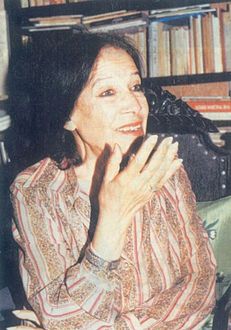
Fadwa Tuqan
فدوى طوقان
Born: Nablus, Mandatory Palestine
Domain: Literature & Poetry
Recognition: Regionally recognized
Biography
Fadwa Tuqan, often called "the Poet of Palestine," was among the most important Arab women poets of the twentieth century and a foundational voice in modern Palestinian poetry. Born in Nablus in 1917 into a prominent but socially conservative family, she was withdrawn from school as a girl and largely confined to the household. Her elder brother, the celebrated poet Ibrahim Tuqan, recognized her gift and privately tutored her in classical and modern Arabic poetry, opening the door to her vocation. Her early work was intensely personal and lyrical, exploring love, longing, and the constrained inner life of a woman in a patriarchal society, themes that themselves carried a quiet feminist charge. Following the death of her brother and her father, and especially after the catastrophe of 1948, her poetry increasingly turned outward toward the collective Palestinian experience of loss and dispossession. The 1967 occupation of the West Bank, including her native Nablus, marked a decisive transformation. Tuqan became one of the leading poets of resistance, writing fierce, dignified verse about occupation, defiance, and steadfastness. Her work from this period circulated widely; the Israeli general Moshe Dayan reportedly remarked that one of her poems was equal to twenty enemy fighters, a measure of the political weight her words carried. Over nearly five decades she published eight collections of poetry along with a celebrated two-part autobiography, "A Mountainous Journey," which became a landmark of Arabic women's life writing. Her poems were translated into English, German, French, Italian, Persian, and Hebrew, and she received numerous honors including the PLO's Jerusalem Medal, the Sultan al-Owais Prize, and the PLO Prize for literature. Tuqan died in Nablus in December 2003, during the siege of the city in the Second Intifada. She is remembered both as a pioneer who expanded the possibilities for Arab women writers and as a national poet whose voice articulated the dignity and sorrow of her people across the decades of the Palestinian tragedy.
Why This Person Matters
Tuqan pioneered modern Arabic women's poetry and became a national voice of Palestinian resistance whose verses carried the weight of armies.
Historical Context
Born in 1917 into a prominent but conservative Nablus family, Fadwa Tuqan was withdrawn from school and largely confined to the household until her brother, the poet Ibrahim Tuqan, secretly tutored her in poetry. Her early lyric work, shadowed by the constraints of a patriarchal society, turned outward after 1948 toward collective loss, and the 1967 occupation of her native Nablus transformed her decisively into a poet of resistance. She wrote her fiercest verse under occupation, and the Israeli general Moshe Dayan reportedly said one of her poems was worth twenty fighters. Her life spanned late Ottoman Palestine through the Second Intifada.
Historical Context
- — Born in Nablus, Mandatory Palestine
- — The Nakba – Palestinian catastrophe and mass displacement
- — Six-Day War and occupation of West Bank and Gaza
- — Passed away at age 86
Selected Works
- I Found It — One of her most celebrated poems, a luminous lyric of self-discovery that became a touchstone of Palestinian women's poetry.
- A Mountainous Journey — Her landmark autobiography tracing her emergence from a sheltered, constrained upbringing to become the voice of Palestinian womanhood and resistance.
Legacy & Influence
Over nearly five decades Tuqan published eight poetry collections and the landmark two-part autobiography 'A Mountainous Journey,' a cornerstone of Arabic women's life writing. Translated into English, German, French, Italian, Persian, and Hebrew, she received the PLO's Jerusalem Medal, the Sultan al-Owais Prize, and the PLO Prize for literature. She is remembered both as a pioneer who expanded the possibilities for Arab women writers and as a national voice of resistance. Her 2003 death during the siege of Nablus in the Second Intifada sealed her place as a poet whose verse carried the dignity and sorrow of her people.
Topics & Themes
- Ottoman Era
- West Bank
References & Sources
- Fadwa Tuqan — https://en.wikipedia.org/wiki/Fadwa_Tuqan
- Palestinian poet Fadwa Tuqan dies | Al Jazeera — https://www.aljazeera.com/news/2003/12/13/palestinian-poet-fadwa-tuqan-dies
- Fadwa Tuqan | Institute for Palestine Studies — https://www.palestine-studies.org/en/node/1650825