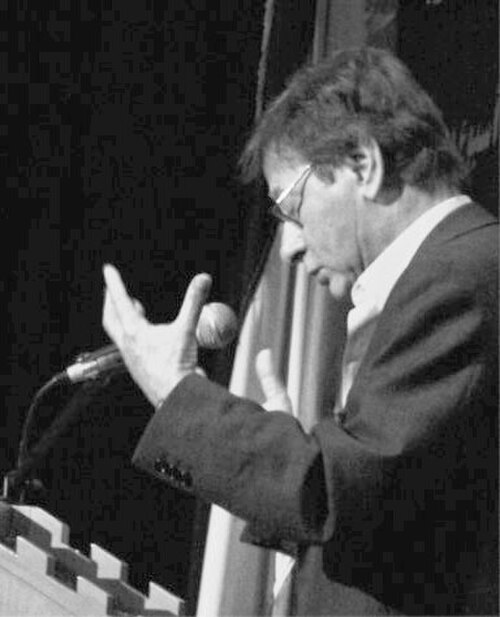
Mahmoud Darwish
محمود درويش
Born: al-Birwa, Mandatory Palestine
Domain: Literature & Poetry
Recognition: Globally recognized
Member of the Palestinian diaspora
Biography
Mahmoud Darwish is widely regarded as the Palestinian national poet and one of the most important Arab poets of the twentieth century. He was born in 1941 in al-Birwa, a village in the western Galilee that was destroyed during the 1948 war, an event that forced his family into temporary exile in Lebanon and later into life as "present-absentees" inside the new state of Israel. The trauma of displacement and the longing for a lost homeland became the central material of his life's work, transmuted into a body of poetry of extraordinary range and lyric power. Darwish published his first collection while still a young man, and his early poem "Identity Card" ("Sajjil ana Arabi" / "Record! I am an Arab") became an anthem of defiance recited across the Arab world. Repeatedly imprisoned and placed under house arrest for his political activity and readings, he left Israel in the early 1970s, beginning decades of exile in Cairo, Beirut, Tunis, Paris, and finally Ramallah. During these years he edited literary journals, served in the Palestine Liberation Organization, and authored the 1988 Palestinian Declaration of Independence. Over a career spanning more than thirty collections of poetry and several volumes of prose, Darwish moved from the directness of resistance poetry toward an increasingly meditative, universal idiom that wove together personal love, exile, myth, and history. Works such as "Memory for Forgetfulness," "Mural," "The Butterfly's Burden," and "In the Presence of Absence" demonstrate a poet continually reinventing his language while remaining anchored in the Palestinian experience. His work was translated into more than twenty languages and earned him international honors including the Lenin Peace Prize, the Lannan Cultural Freedom Prize, the Knight of Arts and Letters medal from France, and the Prince Claus Award. He read to packed stadiums and concert halls, an almost unheard-of phenomenon for a poet, and his verses were set to music and absorbed into the collective memory of millions. When Darwish died in 2008 following heart surgery in the United States, the Palestinian Authority declared three days of national mourning and gave him a state funeral in Ramallah attended by tens of thousands. His grave and the adjacent museum have become a site of pilgrimage. More than any other figure, he gave the Palestinian story a poetic voice that the wider world could hear, transforming a national cause into enduring literature.
Why This Person Matters
Darwish is the poetic voice of the Palestinian people, the writer who turned exile and loss into world literature read in dozens of languages.
Historical Context
Darwish was born in 1941 in al-Birwa, a Galilee village erased during the 1948 war, and his family's flight to Lebanon and clandestine return left them classed as 'present-absentees' inside the new state of Israel. Repeatedly imprisoned and placed under house arrest under military rule, he wrote 'Identity Card' as a young man before leaving in the early 1970s for decades of exile in Cairo, Beirut, Tunis, and Paris. He edited literary journals, served in the PLO, and authored the 1988 Declaration of Independence, before finally settling in Ramallah. His life carried the entire arc of Palestinian displacement, from the Nakba through exile to the limited return of the Oslo era.
Historical Context
- — Born in al-Birwa, Mandatory Palestine
- — The Nakba – Palestinian catastrophe and mass displacement
- — Six-Day War and occupation of West Bank and Gaza
- — Passed away at age 67
Selected Works
- Identity Card — Written in 1964, this defiant declaration of Palestinian identity became one of the most anthologized poems in the Arabic language, opening with the unforgettable line 'Write down: I am an Arab.'
- Memory for Forgetfulness — A lyrical prose meditation written during the 1982 Israeli siege of Beirut, tracing a single day of bombardment through memory, coffee, and longing.
- In the Presence of Absence — Darwish's final major work, a prose-poem addressed to himself in the second person, weaving autobiography and elegy into his most intimate statement.
Legacy & Influence
Across more than thirty collections, Darwish moved from resistance anthems to a meditative, universal idiom in works like 'Memory for Forgetfulness,' 'Mural,' and 'In the Presence of Absence,' translated into more than twenty languages. He read to packed stadiums, his verses set to music and absorbed into the memory of millions, and he won the Lenin Peace Prize, the Lannan Cultural Freedom Prize, and France's Knight of Arts and Letters. His 2008 death brought three days of national mourning and a state funeral attended by tens of thousands; his Ramallah grave and museum are now a place of pilgrimage. More than anyone, he gave the Palestinian story a poetic voice the world could hear.
Topics & Themes
- British Mandate
- Diaspora
References & Sources
- Mahmoud Darwish — https://en.wikipedia.org/wiki/Mahmoud_Darwish
- Mahmoud Darwish | Britannica — https://www.britannica.com/biography/Mahmoud-Darwish
- Mahmoud Darwish | Poetry Foundation — https://www.poetryfoundation.org/poets/mahmoud-darwish