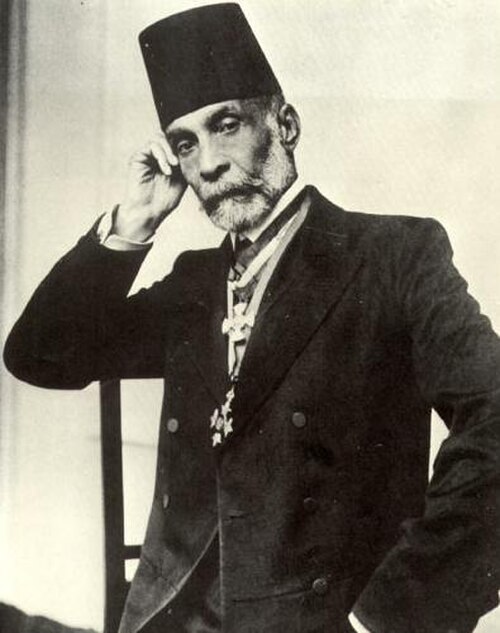
Musa Kazim al-Husseini
موسى كاظم الحسيني
Born: Jerusalem, Ottoman Empire
Domain: Politics & Diplomacy
Recognition: Regionally recognized
Biography
Musa Kazim Pasha al-Husseini was the venerable elder statesman of the early Palestinian national movement and its principal leader in the first decade of the British Mandate. Born in Jerusalem in 1853 into the prominent Husseini family, which had long supplied the city with mayors and muftis, he served the Ottoman Empire as an administrator across several provinces before returning to Jerusalem, where he became mayor in 1918 in the immediate aftermath of Ottoman collapse and British occupation. The British dismissed him as mayor in 1920 after he participated in nationalist demonstrations protesting the Balfour Declaration and Zionist immigration. Rather than retiring from politics, he stepped fully into the national leadership, and at the Third Palestine Arab Congress held in Haifa in December 1920 he was chosen as chairman of the Arab Executive Committee, the body that emerged to represent Palestinian Arab national demands. He held the chairmanship of the Arab Executive until his death, making him the recognized figurehead of organized Palestinian nationalism throughout the 1920s. In this capacity he led delegations to London to lobby the British government against the Mandate's pro-Zionist provisions, articulated Palestinian opposition to the Balfour Declaration, and sought to unify the country's fractious political factions under a constitutional and diplomatic strategy of opposition. Despite his advanced age, he remained personally active in popular protest. In October 1933, at the age of eighty, he led mass demonstrations in Jerusalem and Jaffa against British policy on Jewish immigration and Arab land transfers. At the Jaffa demonstration he was struck on the head by a mounted British policeman, an injury from which he never fully recovered, and he died in March 1934. Musa Kazim al-Husseini represents the founding generation of Palestinian political leadership that arose at the moment of Ottoman dissolution and British rule. As the long-serving father figure of the Arab Executive Committee, he established the institutional and diplomatic foundations of the national movement that later, more famous leaders would inherit and contest.
Why This Person Matters
Musa Kazim al-Husseini was the founding father figure of organized Palestinian nationalism, leading the Arab Executive Committee through the 1920s and dying from injuries sustained while protesting British policy.
Historical Context
Musa Kazim belonged to the Ottoman administrative elite, an experienced provincial governor whose long career ended just as the empire he served collapsed and the British marched into Jerusalem. Made mayor of the city in 1918, he was dismissed in 1920 for joining demonstrations against the Balfour Declaration, a turn that pushed him from imperial service into national leadership at the very birth of organized Palestinian politics. As chairman of the Arab Executive Committee through the 1920s, he confronted the new Mandate's pro-Zionist provisions through congresses, delegations to London, and constitutional opposition. His era was the founding decade in which a stateless people first built representative institutions under colonial rule.
Historical Context
- — Born in Jerusalem, Ottoman Empire
- — The Nakba – Palestinian catastrophe and mass displacement
- — Six-Day War and occupation of West Bank and Gaza
- — Passed away at age 81
Legacy & Influence
Musa Kazim is remembered as the founding father figure of organized Palestinian nationalism, the elder statesman who established the institutional and diplomatic foundations later leaders would inherit. His death gave the movement one of its earliest martyrs: at eighty he led demonstrations in Jerusalem and Jaffa in 1933, was struck by a mounted British policeman, and never recovered, dying in 1934. That image of an octogenarian beaten in the street while protesting British immigration policy fixed him in national memory as the embodiment of dignified, constitutional resistance. His grandson Faisal Husseini and the wider Husseini line carried his political inheritance into later generations.
Topics & Themes
- Ottoman Era
- Jerusalem
References & Sources
- Musa Kazim Husseini (1853-1934) - Institute for Palestine Studies — https://www.palestine-studies.org/en/node/1651107
- Musa al-Husayni - Wikipedia — https://en.wikipedia.org/wiki/Musa_Kazim_al-Husayni
- Musa Kazim al-Husseini - Jerusalem Story — https://www.jerusalemstory.com/en/bio/musa-kazim-al-husseini