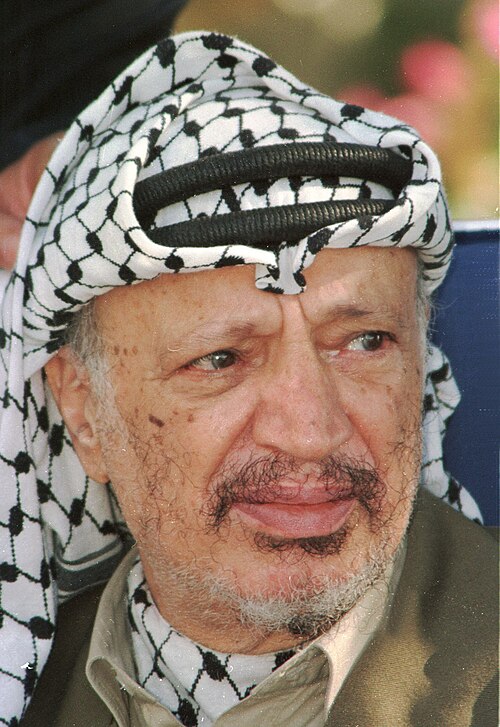
Yasser Arafat
ياسر عرفات
Born: Cairo, Egypt
Domain: Politics & Diplomacy
Recognition: Globally recognized
Biography
Mohammed Yasser Abdel Rahman Abdel Raouf Arafat al-Qudwa, known to the world as Yasser Arafat and by his nom de guerre Abu Ammar, was the defining figure of modern Palestinian nationalism. Born in 1929 to a Palestinian family, with his birthplace disputed between Cairo and Jerusalem, he studied engineering at King Fuad I University (later Cairo University) and was active in Palestinian student politics before co-founding the Fatah movement in the late 1950s with associates including Khalil al-Wazir. Fatah committed to armed struggle for the liberation of Palestine and would become the dominant faction within the Palestinian national movement. In 1969 Arafat became chairman of the Palestine Liberation Organization (PLO), transforming it from an instrument of Arab states into an independent vehicle of Palestinian self-determination. For more than three decades he embodied the Palestinian cause on the world stage, surviving exile from Jordan after Black September in 1970, relocation to Lebanon, the 1982 Israeli siege of Beirut, and subsequent headquarters in Tunis. His 1974 address to the United Nations General Assembly, where he spoke of carrying both an olive branch and a freedom fighter's gun, marked the international arrival of the Palestinian question. Arafat's signature political pivot came in 1988, when the Palestinian National Council declared independence and implicitly accepted a two-state solution, followed by his renunciation of terrorism and recognition of Israel. This trajectory culminated in the 1993 Oslo Accords, signed on the White House lawn, which established mutual recognition between the PLO and Israel and created the Palestinian Authority. In 1994 Arafat shared the Nobel Peace Prize with Yitzhak Rabin and Shimon Peres and returned from exile to Gaza and the West Bank to head the new Authority as its first president. The later years of his leadership were marked by the failure of the 2000 Camp David summit, the eruption of the Second Intifada, and his confinement by Israeli forces to his Ramallah compound, the Muqata'a, from 2002 until shortly before his death. He died in a Paris hospital in November 2004 under circumstances that remain contested, with later investigations raising but not conclusively proving the possibility of poisoning. Arafat remains the towering symbol of the Palestinian national project, credited with placing Palestinian statehood at the center of global diplomacy and with forging a unified national identity in exile. Critics across the spectrum fault him for authoritarian governance, the unresolved compromises of Oslo, and tolerance of corruption, but few dispute that no individual did more to make Palestine a recognized political subject of the twentieth century.
Why This Person Matters
Arafat single-handedly placed Palestinian statehood at the heart of world diplomacy and forged a unified national identity from exile, becoming the most recognizable Palestinian of the twentieth century.
Historical Context
Arafat came of age in the catastrophe of 1948 and the wreckage of Arab defeat, founding Fatah at the end of the 1950s when stateless Palestinians had been reduced to refugees and clients of Arab regimes. The 1967 war, which placed the West Bank and Gaza under Israeli occupation and exposed the bankruptcy of pan-Arab nationalism, opened the space for him to seize the PLO in 1969 and turn it into an autonomous national vehicle. His life mapped onto every station of the Palestinian exile: expulsion from Jordan in Black September, the Beirut years and the 1982 Israeli siege, the long banishment in Tunis, and finally the qualified return enabled by Oslo. He died besieged in the Muqata'a during the Second Intifada, his confinement a literal image of a nation hemmed in.
Historical Context
- — Born in Cairo, Egypt
- — The Nakba – Palestinian catastrophe and mass displacement
- — Six-Day War and occupation of West Bank and Gaza
- — Passed away at age 75
Legacy & Influence
Arafat is remembered as the man who made Palestine an inescapable item on the world's agenda, securing the PLO's recognition as the sole legitimate representative of the Palestinian people and his own 1974 address to the UN General Assembly. His 1993 handshake on the White House lawn and his shared 1994 Nobel Peace Prize defined the era of negotiated statehood, even as the Palestinian Authority he built remains the institutional skeleton of self-rule. His keffiyeh, folded in the shape of historic Palestine, became a global emblem of the cause. He endures as the contested father of the national project, invoked by successors and critics alike as the figure no Palestinian leader has equaled.
Topics & Themes
- British Mandate
References & Sources
- Yasser Arafat | Biography, History, & Facts — https://www.britannica.com/biography/Yasser-Arafat
- Yasser Arafat - Nobel Peace Prize 1994 — https://www.nobelprize.org/prizes/peace/1994/arafat/facts/
- Yasser Arafat - Wikipedia — https://en.wikipedia.org/wiki/Yasser_Arafat