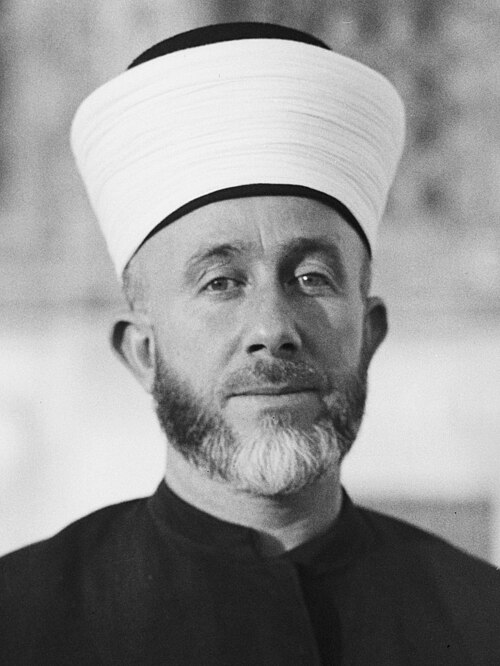
Haj Amin al-Husseini
الحاج أمين الحسيني
Born: Jerusalem, Ottoman Empire
Domain: Politics & Diplomacy
Recognition: Globally recognized
Biography
Mohammed Amin al-Husseini was the dominant and most controversial Palestinian Arab political and religious leader during the British Mandate period. Born in Jerusalem around 1897 into the powerful Husseini clan of landowners and religious notables, and son of the city's mufti, he was educated in Islamic, Ottoman, and French Catholic schools and served as an artillery officer in the Ottoman army during the First World War. In 1921 the British High Commissioner Herbert Samuel appointed him Grand Mufti of Jerusalem, and he was subsequently made president of the newly created Supreme Muslim Council, the most authoritative religious institution in Mandate Palestine. From these positions he commanded extensive religious endowments and patronage networks, consolidating unrivaled influence over Palestinian Arab society and emerging as the foremost leader of opposition to Zionism and Jewish immigration. He presided over the politicization of the al-Aqsa and Buraq (Western Wall) disputes, played a central role in the 1929 disturbances and the major 1936-1939 Arab Revolt against British rule and Zionist land purchases, and chaired the Arab Higher Committee. British repression of the revolt forced him into exile, and from the late 1930s he operated from Lebanon, Iraq, and ultimately Axis Europe. His wartime years in Nazi Germany, where he met Hitler, broadcast propaganda, and sought Axis support against Zionism and the British, made him one of the most internationally notorious figures of the Palestinian movement and remain the subject of intense and polarized historical debate. After the war he resumed leadership of the fragmented Arab Higher Committee from exile, presiding over the catastrophic Palestinian defeat of 1948, before his influence waned. He died in Beirut in 1974. Al-Husseini's legacy is deeply divisive: to many Palestinians he was the foremost national leader of the Mandate era who organized sustained resistance to colonial and Zionist designs, while to critics his authoritarian methods, factional violence, and wartime collaboration with the Axis represent a damaging chapter. Either way, he was the single most consequential Palestinian political figure of the first half of the twentieth century.
Why This Person Matters
Al-Husseini was the paramount Palestinian Arab leader of the Mandate era who organized sustained resistance to Zionism, remaining one of the most consequential and contested figures in Palestinian history.
Historical Context
Al-Husseini emerged from the Jerusalem notable class at the precise hinge of history when Ottoman rule collapsed and the British Mandate, committed by the Balfour Declaration to a Jewish national home, took its place. Appointed Grand Mufti in 1921 and head of the Supreme Muslim Council, he built his power on religious endowments and the politicization of the al-Aqsa and Buraq disputes, leading Arab opposition through the 1929 disturbances and the great 1936-1939 Revolt. British repression drove him into an exile that carried him through Lebanon and Iraq to wartime Nazi Germany, where his sought-after Axis alliance against Zionism and Britain became the most notorious and debated episode of his life. He returned to preside, from exile, over the Palestinian catastrophe of 1948.
Historical Context
- — Born in Jerusalem, Ottoman Empire
- — The Nakba – Palestinian catastrophe and mass displacement
- — Six-Day War and occupation of West Bank and Gaza
- — Passed away at age 77
Legacy & Influence
Al-Husseini remains the single most consequential Palestinian political figure of the Mandate's first half, and one of the most divisive in the national memory. To many Palestinians he embodied the organized resistance to colonial and Zionist designs that defined the era; to his critics his authoritarian methods, the factional bloodletting he fostered, and above all his wartime collaboration with the Axis are a damaging inheritance still invoked in polemics today. His career institutionalized the religious framing of the conflict over Jerusalem that echoes into the present. He endures as a figure historians cannot agree on and Palestinians cannot ignore.
Topics & Themes
- Ottoman Era
- Jerusalem
References & Sources
- Amin al-Husseini | Biography, Family, Jerusalem, & Palestine — https://www.britannica.com/biography/Amin-al-Husayni
- Amin al-Husseini - Wikipedia — https://en.wikipedia.org/wiki/Amin_al-Husseini
- Amin al-Husseini - Jerusalem Story — https://www.jerusalemstory.com/en/bio/amin-al-husseini