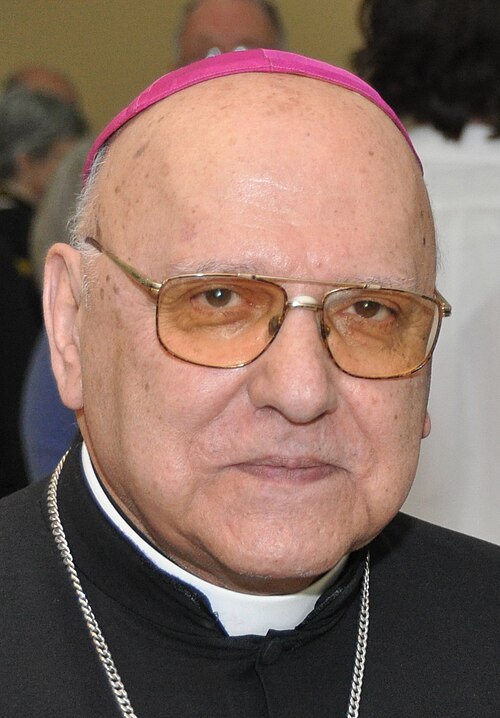
Michel Sabbah
ميشيل صبّاح
Born: Nazareth, Mandatory Palestine
Domain: Civil Society & Religion
Recognition: Globally recognized
Biography
Michel Sabbah is a Palestinian Catholic prelate who made history as the first native Palestinian Latin Patriarch of Jerusalem, breaking more than five centuries of exclusively Italian and European tenure of the office. Born in Nazareth in 1933 in Mandatory Palestine, he entered the Latin Patriarchal Seminary of Beit Jala in 1949 and was ordained a priest of the Latin Patriarchate of Jerusalem in 1955. He pursued advanced studies in Arabic language and philology, earning a doctorate, and devoted much of his early career to education, including serving as president of Bethlehem University. His scholarly grounding in Arabic and his pastoral work in the local church shaped his lifelong conviction that the Christian presence in the Holy Land is indigenous, Arab and Palestinian, not a foreign transplant. In 1987 Pope John Paul II appointed him Latin Patriarch of Jerusalem, a watershed that gave Palestinian Christians a leader from among their own people. Over more than two decades in the office, until his retirement in 2008, Sabbah became an outspoken advocate of justice, human rights and nonviolence, issuing pastoral letters that addressed the political realities of occupation while insisting on reconciliation and the equal dignity of all peoples in the land. His influence extended well beyond his diocese. From 1999 to 2007 he served as international president of Pax Christi, the global Catholic peace movement, and he became a leading voice in interreligious dialogue and in initiatives such as the Kairos Palestine document, a Christian call for justice and hope. His combination of religious authority and moral clarity made him a respected figure in churches and human rights circles worldwide. For civil society and religion, Sabbah matters as the embodiment of an authentically Palestinian Christianity and as a global advocate who linked faith to peacemaking and human dignity. As patriarch emeritus he has continued to speak and write, remaining one of the most internationally recognized Palestinian religious leaders of his generation.
Why This Person Matters
The first native Palestinian Latin Patriarch of Jerusalem in over five centuries, Sabbah embodied an indigenous Arab Christianity and became a globally recognized advocate of justice, nonviolence and interreligious peace.
Historical Context
Michel Sabbah was born in Nazareth in 1933, during the final years of British Mandatory Palestine, and came of age amid the upheaval that culminated in the 1948 Nakba and the dismemberment of Palestinian society. He entered the Beit Jala seminary in 1949, just after the war, and was ordained in 1955, building his clerical life within a Latin Patriarchate long dominated by Italian and European prelates. His scholarly immersion in Arabic language and his pastoral service, including the presidency of Bethlehem University, unfolded under the realities of occupation after 1967. When Pope John Paul II named him patriarch in 1987, on the eve of the First Intifada, the appointment gave Palestinian Christians a leader drawn from their own dispossessed people for the first time in over five centuries.
Historical Context
- — Born in Nazareth, Mandatory Palestine
- — The Nakba – Palestinian catastrophe and mass displacement
- — Six-Day War and occupation of West Bank and Gaza
Legacy & Influence
Sabbah's legacy rests on his redefinition of the Latin Patriarchate as an indigenous, Arab and Palestinian church rather than a European outpost, a transformation symbolized by his very person. His pastoral letters on justice, nonviolence and reconciliation under occupation remain reference points for the local church, and his presidency of Pax Christi International from 1999 to 2007 carried his moral voice into the global Catholic peace movement. He was among the senior signatories of the 2009 Kairos Palestine document, a landmark Christian call for justice that continues to shape ecumenical advocacy worldwide. As patriarch emeritus he is still invoked as one of the most internationally respected Palestinian religious leaders, a living bridge between faith, human dignity and the cause of his people.
Topics & Themes
- British Mandate
References & Sources
- Michel Sabbah — https://en.wikipedia.org/wiki/Michel_Sabbah
- Patriarch Michel Sabbah - Latin Patriarchate of Jerusalem — https://lpj.org/en/the-patriarchate/diocese/patriarchs-1/viii-patrichae-michel-sabbah
- 90 Years, 90 Heroes: Patriarch Michel Sabbah - CNEWA — https://cnewa.org/90-years-90-heroes-patriarch-michel-sabbah-53121/