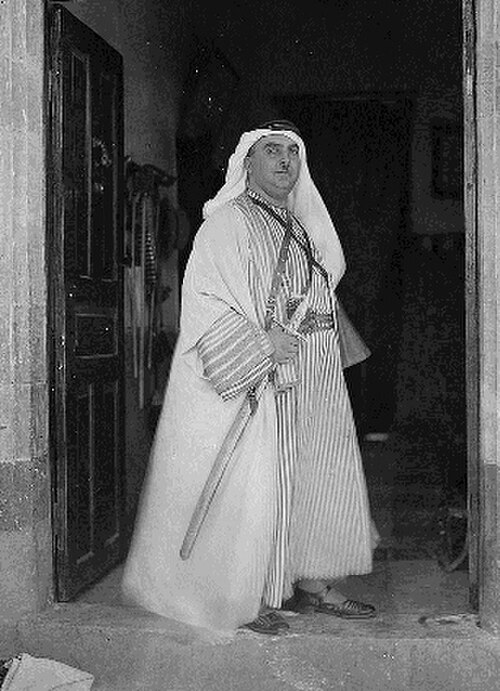
Aref al-Aref
عارف العارف
Born: Jerusalem, Ottoman Palestine
Domain: Civil Society & Religion
Recognition: Regionally recognized
Biography
Aref al-Aref was a Palestinian journalist, historian, administrator and civic leader whose long career spanned the late Ottoman period, the British Mandate and the aftermath of the Nakba. Born Aref Shehadeh in Jerusalem in 1892, he studied in Istanbul and served in the Ottoman army during the First World War, was captured and held as a prisoner in Russia, and emerged from that experience as a committed Arab nationalist. Returning to Jerusalem, in 1919 he became editor of Suriya al-Janubiya (Southern Syria), the first Arab nationalist newspaper published in the city, which made him a leading voice of the early national movement and entangled him in the political ferment surrounding the Nebi Musa events of 1920. Pursued by the authorities, he later moved into public administration, serving as a district officer in various parts of Palestine and Transjordan, where he combined governance with a deep ethnographic interest in Bedouin society and tribal law. Al-Aref's most enduring contribution lies in his scholarship. A prolific writer, he produced foundational works on the history of Jerusalem, on Beersheba and its Bedouin tribes, and on Gaza, becoming known as the dean of Palestinian historians. His meticulous documentation preserved social customs, place-names and communal memory that might otherwise have been lost amid upheaval. After 1948 he turned his pen to catastrophe itself, compiling the multi-volume Nakbat Filastin (The Palestinian Catastrophe), an encyclopedic chronicle that helped fix the very term Nakba in collective consciousness and recorded the destroyed villages and displaced communities of his homeland. From 1949 to 1955 he also served as mayor of East Jerusalem, continuing a lifelong commitment to the city's civic and cultural life. For civil society and heritage, al-Aref matters as the archivist of a people's memory: the writer who insisted that Palestinian history, customs and losses be recorded with rigor. His books remain primary references for scholars, and his career models the engaged intellectual who serves community through journalism, administration and history alike. He died in al-Bireh in 1973.
Why This Person Matters
Known as the dean of Palestinian historians, al-Aref documented Jerusalem, the Bedouin and the Nakba itself, becoming the archivist of his people's memory and helping fix the term Nakba in collective consciousness.
Historical Context
Aref al-Aref's life spanned every great rupture in modern Palestinian history. Born in Jerusalem in 1892 under late Ottoman rule, he fought in the Ottoman army in the First World War, endured captivity in Russia, and emerged a committed Arab nationalist. In 1919 he edited Suriya al-Janubiya, the first Arab nationalist newspaper in Jerusalem, becoming entangled in the Nebi Musa events of 1920 at the dawn of the British Mandate. He then served as a district administrator across Palestine and Transjordan, gaining intimate knowledge of Bedouin society. The 1948 Nakba turned his historian's eye to catastrophe itself, and he chronicled the destroyed villages and displaced communities of his own homeland.
Historical Context
- — Born in Jerusalem, Ottoman Palestine
- — The Nakba – Palestinian catastrophe and mass displacement
- — Six-Day War and occupation of West Bank and Gaza
- — Passed away
Legacy & Influence
Al-Aref's enduring legacy is as the dean of Palestinian historians, whose foundational works on Jerusalem, on Beersheba and its Bedouin, and on Gaza preserved customs, place-names, and communal memory that might otherwise have vanished. His multi-volume Nakbat Filastin helped fix the very term Nakba in collective consciousness and stands as an encyclopedic record of the destroyed villages of 1948. As mayor of East Jerusalem from 1949 to 1955 he continued his lifelong service to the city's civic and cultural life. His books remain primary references for scholars, and he endures as the archivist of his people's memory and a model of the engaged intellectual serving community through journalism, administration, and history.
Topics & Themes
- Ottoman Era
- Jerusalem
References & Sources
- Aref al-Aref — https://en.wikipedia.org/wiki/Aref_al-Aref
- Aref al-Aref - Interactive Encyclopedia of the Palestine Question — https://www.palquest.org/en/biography/16023/aref-al-aref
- Arif, Arif Al- (1892-1973) - Encyclopedia.com — https://www.encyclopedia.com/politics/dictionaries-thesauruses-pictures-and-press-releases/arif-arif-al-1892-1973