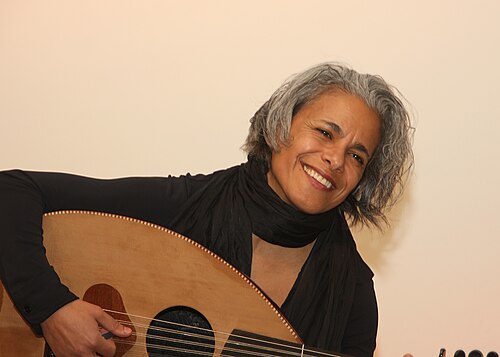
Kamilya Jubran
كاميليا جبران
Born: Rameh, Israel
Domain: Music
Recognition: Globally recognized
Member of the Palestinian diaspora
Biography
Kamilya Jubran, born in 1962 in the Galilee village of Rameh to a Palestinian family, is one of the most important voices in modern Palestinian music and a pioneer of its avant-garde. Her father, Elias, was a music teacher and a maker of traditional instruments such as the oud, and she grew up steeped in classical Arabic repertoire, learning oud and qanun in a deeply musical household. After moving to Jerusalem in 1981, she joined the legendary group Sabreen in 1982, becoming its lead singer and qanun player for two decades. Under composer Said Murad, Sabreen forged a new Palestinian musical language, blending traditional instruments with cello, contrabass, and violin and setting modern Palestinian poetry to richly experimental arrangements. Their albums, released at key political moments such as the 1982 Israeli invasion of Lebanon and the First Intifada, became anthems of a generation and redefined what committed Palestinian music could sound like. In 2002 Jubran left Sabreen and Palestine to pursue a radical solo path, relocating to Europe. Working with electronic musicians and composers, she stripped her art down to voice and oud and then expanded it into experimental and electroacoustic territory, with landmark albums including Mahattaat and Wameedd. Her 2008 project Makan, exploring identity and place, confirmed her as a singular artist who refuses easy categorization. Beyond her own performances, Jubran has become a mentor and institution-builder. In 2014 she founded the nonprofit Zamkana to support original artistic projects and freedom of expression, and she established Sodassi, a music residency offering masterclasses in composition and arrangement for young Arab artists, with particular attention to young women. Through these efforts she has shaped a new generation of Arab experimental musicians. Jubran has performed across Europe, the Arab world, and beyond, collaborating with leading figures in contemporary and improvised music and earning recognition from institutions such as the Aga Khan Music Programme. Her uncompromising artistry has made her a reference point for those seeking to renew Arabic song from within. Her trajectory, from the heart of committed Palestinian collective music to the frontiers of solo experimentation, makes her a bridge between the engaged music of the Intifada generation and the boundary-crossing global art music of the present.
Why This Person Matters
As the voice of Sabreen and then a pioneering solo experimentalist, she redefined committed Palestinian music and bridged the Intifada generation with the global avant-garde.
Historical Context
Kamilya Jubran was born in 1962 in the Galilee village of Rameh, the daughter of a music teacher and oud-maker, and grew up steeped in classical Arabic repertoire as a Palestinian inside Israel. Moving to Jerusalem in 1981, she joined Sabreen in 1982 just as Palestinian political life was convulsed by the Israeli invasion of Lebanon and then the First Intifada. Sabreen's experimental settings of modern Palestinian poetry, released at exactly these flashpoints, made the group's albums anthems of a generation in revolt. Her 2002 departure for Europe coincided with the collapse of the Oslo promise and the Second Intifada, opening a radically different, exilic chapter in her art.
Historical Context
- — Born in Rameh, Israel
- — Six-Day War and occupation of West Bank and Gaza
Selected Works
- Wameedd — Her 2008 album sets poems by Mahmoud Darwish, Samih al-Qasim and others to music for oud and electronics, in a collaboration with Swiss composer Werner Hasler that won wide critical acclaim.
Legacy & Influence
Jubran's two-decade voice in Sabreen helped redefine committed Palestinian music, and her solo turn — through landmark albums such as Mahattaat, Wameedd, and the Makan project — established her as a singular avant-garde artist who renews Arabic song from within. Beyond her own work she has become an institution-builder, founding the nonprofit Zamkana in 2014 and the Sodassi music residency to mentor young Arab experimental musicians, with particular attention to young women. Recognized by bodies such as the Aga Khan Music Programme and collaborating with leading figures in improvised music, she stands as a bridge between the engaged music of the Intifada generation and today's boundary-crossing global art music. Her uncompromising path has made her a reference point for a whole emerging field of Arab experimentation.
Topics & Themes
- Nakba Generation
- Diaspora
References & Sources
- Kamilya Jubran — https://en.wikipedia.org/wiki/Kamilya_Jubran
- Kamilya Jubran — Aga Khan Music Programme — https://the.akdn/en/how-we-work/our-agencies/aga-khan-trust-culture/akma/kamilya-jubran
- Kamilya Jubran, Palestinian singer, songwriter, and multi-instrumentalist — https://worldmusiccentral.org/kamilya-jubran-palestinian-singer-songwriter-and-multi-instrumentalist/