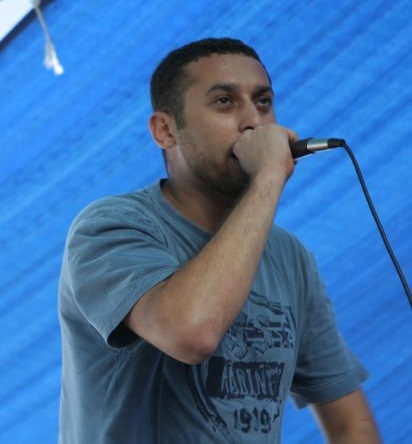
Tamer Nafar (DAM)
تامر النفّار (دام)
Born: Lod, Israel
Domain: Music
Recognition: Globally recognized
Biography
Tamer Nafar, born on 6 June 1979 in the mixed city of Lod (Lydda), is a Palestinian rapper, actor, screenwriter, and activist, and the founder and leader of DAM, the first Palestinian hip-hop group. He grew up in a neighborhood scarred by poverty, drugs, and crime, and discovered hip-hop at seventeen, teaching himself English by listening to Tupac Shakur and translating the lyrics into Arabic with a dictionary. Nafar released his first EP, Stop Selling Drugs, in 1998, and in 2000 joined with his younger brother Suhell and friend Mahmoud Jreri to form DAM, a name that is an acronym for Da Arab MCs and also means 'lasting' in Arabic and 'blood' in Hebrew. The group pioneered Arabic-language hip-hop and gave a defiant new voice to a generation of Palestinians living as second-class citizens inside Israel. DAM's breakthrough came with the 2001 song 'Min Irhabi' (Who's the Terrorist?), a furious response to the violence of the Second Intifada that was downloaded more than a million times and made the group a household name among Arab youth across the Middle East. Rapping in Arabic, Hebrew, and English, DAM addressed occupation, discrimination, poverty, and, controversially within their own society, the oppression of women, expanding the scope of Palestinian protest music. Nafar's influence extends well beyond DAM's recordings. He has been the central figure in the global emergence of Palestinian and Arab hip-hop, inspiring countless younger artists from Gaza to the diaspora and demonstrating that rap could be a vehicle for Palestinian narrative on the world stage. The 2008 documentary Slingshot Hip Hop brought DAM's story to international audiences. He has also built a parallel career in film, co-starring in and co-writing the acclaimed feature Junction 48 (2016), and performing at the Academy Awards-adjacent and international festival circuit. His work consistently fuses art and activism, refusing the separation between the two. As the artist who, more than any other, put Palestinian hip-hop on the map, Tamer Nafar transformed the language of global protest music into a Palestinian idiom and gave a marginalized generation both a mirror and a megaphone.
Why This Person Matters
He founded Palestinian hip-hop with DAM, turning rap into a Palestinian idiom and giving a marginalized generation a global voice with anthems like 'Who's the Terrorist?'
Historical Context
Tamer Nafar was born in 1979 in the mixed city of Lod (Lydda), a town emptied and reshaped in 1948 whose Palestinian residents lived afterward amid poverty, neglect, and crime. He discovered hip-hop at seventeen, teaching himself English through Tupac, and founded DAM with his brother and a friend in 2000 — giving voice to a generation of Palestinians who were citizens of Israel yet treated as second-class. The group's breakthrough, 'Min Irhabi' (Who's the Terrorist?), erupted directly out of the Second Intifada's violence in 2001. DAM's bilingual rap, in Arabic, Hebrew, and English, spoke from the specific predicament of the Palestinians inside the Green Line.
Historical Context
- — Born in Lod, Israel
Selected Works
- Meen Erhabi? (Who's the Terrorist?) — Their 2001 breakthrough track — a bilingual Arabic-Hebrew hip-hop challenge to Israeli state violence — is credited as the founding work of Palestinian rap and went viral before that term existed.
- Born Here — A landmark hip-hop track confronting the experience of Palestinian citizens inside Israel — born in their homeland yet treated as outsiders — that brought DAM to international attention.
Legacy & Influence
Nafar effectively founded Palestinian hip-hop, turning rap into a Palestinian idiom and inspiring countless younger artists from Gaza to the diaspora. 'Who's the Terrorist?' was downloaded more than a million times and made DAM a household name among Arab youth, while the 2008 documentary Slingshot Hip Hop carried their story worldwide. DAM widened the scope of Palestinian protest music to confront not only occupation and discrimination but also, controversially within their own society, the oppression of women. Through his parallel film career, including co-writing and starring in Junction 48 (2016), Nafar fused art and activism, and stands as the artist who, more than any other, gave a marginalized generation both a mirror and a megaphone.
Topics & Themes
- Post-1967
References & Sources
- DAM (band) — https://en.wikipedia.org/wiki/DAM_(band)
- Tamer Nafar — https://en.wikipedia.org/wiki/Tamer_Nafar
- Tamer Nafar: Making Palestinian Hip Hop Mainstream — https://www.arabamerica.com/tamer-nafar-making-palestinian-hip-hop-mainstream/