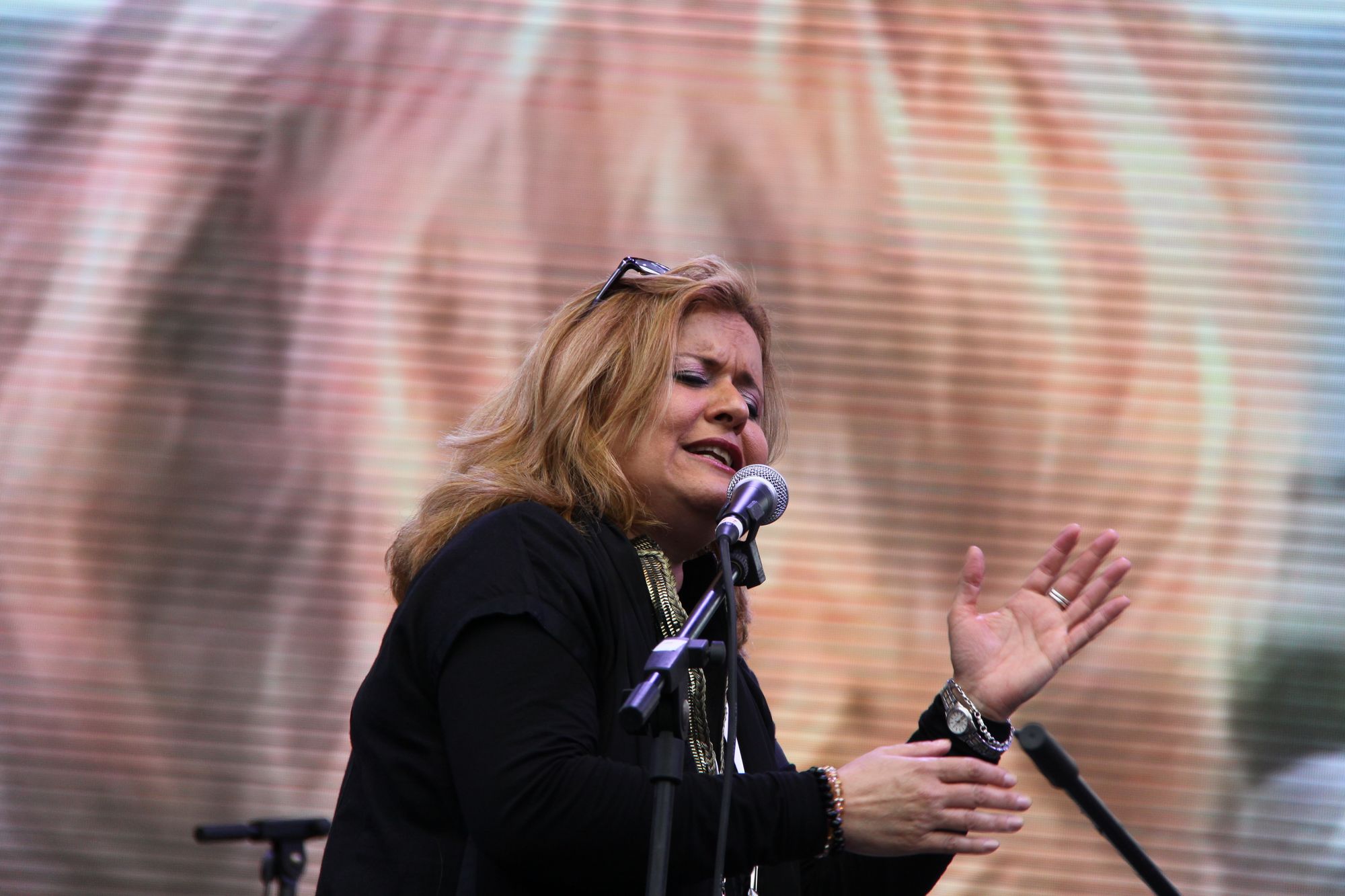
Reem Kelani
ريم كيلاني
Born: Manchester, United Kingdom
Domain: Music
Recognition: Globally recognized
Member of the Palestinian diaspora
Biography
Reem Kelani, born in Manchester in 1963 to Palestinian parents from Yabad near Jenin and from Nazareth, is a singer, musicologist, broadcaster, and educator who has become one of the foremost custodians and interpreters of Palestinian musical heritage in the diaspora. Raised in Kuwait, she absorbed musical influences from across the Gulf, Iraq, Iran, Yemen, India, and East Africa, before settling in London, where she has built her career. Kelani trained originally as a biologist, taking a science degree from Kuwait University, and turned to music professionally only in 1990. This unusual path informs the scholarly rigor she brings to her work: she approaches Palestinian song not merely as a performer but as a researcher, collecting, documenting, and arranging material gathered from refugee communities and from her own family in Galilee. Her landmark debut album, Sprinting Gazelle: Palestinian Songs from the Motherland and the Diaspora (2006), is the fruit of years of fieldwork, gathering songs from Palestine and from refugee camps in Lebanon and giving them powerful new jazz-inflected arrangements. The album was widely acclaimed and established her internationally as a singer of extraordinary range and as a serious ethnomusicologist working to preserve a threatened heritage. Beyond Palestinian repertoire, Kelani has undertaken major projects on the Egyptian composer Sayyid Darwish, demonstrating her breadth as a scholar of Arab music. She has toured internationally with her band, performing across Europe, the Middle East, China, and the United States, and has worked extensively as a broadcaster for the BBC and other outlets, bringing Arab music to wide English-speaking audiences. As an educator, Kelani has pioneered the teaching of Arabic and Palestinian song in British schools and lectured at institutions such as Goldsmiths, University of London. Her commitment to passing on the tradition, especially to young people in the diaspora, has made her an influential cultural ambassador. Through performance, scholarship, broadcasting, and teaching, Reem Kelani has ensured that Palestinian musical heritage is not only preserved but understood, contextualized, and celebrated on the international stage, embodying the creative resilience of the Palestinian diaspora.
Why This Person Matters
Both a powerful performer and a serious ethnomusicologist, she has collected, preserved, and projected Palestinian song onto the world stage, becoming the diaspora's leading custodian of the tradition.
Historical Context
Reem Kelani was born in Manchester in 1963 to Palestinian parents from Yabad near Jenin and from Nazareth, and was raised in Kuwait amid the cosmopolitan musical cross-currents of the Gulf before settling in London. Her life embodies the diaspora condition that the Nakba and subsequent dispersals created: a Palestinian heritage carried, preserved, and re-rooted far from the homeland. Trained first as a biologist, she turned to music in 1990 and brought a researcher's discipline to gathering songs from refugee camps in Lebanon and from her own family in Galilee. Her work is thus shaped by the scattering of Palestinians across the Middle East and the West, and by the urgency of preserving a heritage threatened with loss.
Historical Context
- — Born in Manchester, United Kingdom
- — Six-Day War and occupation of West Bank and Gaza
Selected Works
- Sprinting Gazelle – Palestinian Songs from the Motherland and the Diaspora — Her landmark 2006 debut album collects and re-presents Palestinian folk songs — lullabies, wedding songs, and work songs — in her rich contralto voice, a major act of musical preservation and cultural rescue.
Legacy & Influence
Kelani's landmark album Sprinting Gazelle (2006), the fruit of years of fieldwork, established her internationally as both a singer of extraordinary range and a serious ethnomusicologist preserving a threatened heritage. Her broader scholarship, including major projects on the Egyptian composer Sayyid Darwish, and her extensive BBC broadcasting have brought Arab music to wide English-speaking audiences. As a pioneer of teaching Arabic and Palestinian song in British schools and a lecturer at institutions such as Goldsmiths, she has shaped how the tradition is transmitted to diaspora youth. Through performance, scholarship, broadcasting, and teaching together, she has become the diaspora's leading custodian of Palestinian song, ensuring it is not merely preserved but understood and contextualized.
Topics & Themes
- Nakba Generation
- Diaspora
References & Sources
- Reem Kelani — https://en.wikipedia.org/wiki/Reem_Kelani
- Reem Kelani — Biography — https://www.reemkelani.com/page_biog.asp
- Reem Kelani — All About Jazz — https://www.allaboutjazz.com/musicians/reem-kelani