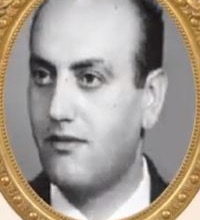
Yousef Khasho
يوسف خاشو
Born: Jerusalem, British Mandate Palestine
Domain: Music
Recognition: Regionally recognized
Member of the Palestinian diaspora
Biography
Yousef Khasho, born in Jerusalem in 1927, was the most ambitious symphonic composer of the Palestinian classical tradition, often called the Beethoven of the Arabs. A student of Augustin Lama, he inherited the foundational pedagogy of Palestinian art music and pushed it into the largest forms of the European canon, writing symphonies that fused Western orchestral language with the sonic and spiritual world of his homeland. His most celebrated work is his fourth symphony, a programmatic depiction of Jerusalem's turmoil from 1948 to 1967. In one of its most arresting passages, Khasho intertwines a Gregorian Kyrie with the Muslim call to prayer, a musical embodiment of the city's interwoven Christian and Islamic identities. The final movement gives voice to the grief and anger of Palestinians in the aftermath of the 1967 war, transforming national catastrophe into monumental orchestral statement. Khasho's career unfolded against the backdrop of dispossession and exile. Like Arnita and so many Palestinian artists, his life was shaped by the loss of Jerusalem and the dispersal of its cultural world, and much of his work can be read as an elegy for a city and a people. He continued composing through the decades, building a body of symphonic and choral music that remains among the most substantial achievements of any Arab composer in the European tradition. Though his music is rarely performed and recordings are scarce, Khasho occupies a place of honor in the historiography of Palestinian and Arab classical music. Scholars cite him as proof that Palestinians produced not only folk and popular traditions but also composers capable of the largest and most demanding forms of Western art music. He died in 1996. His symphonies stand as a sonic monument to twentieth-century Palestinian history, an attempt to render the Nakba, the loss of Jerusalem, and the endurance of his people in the language of the symphony orchestra. Khasho's achievement demonstrates the breadth of Palestinian musical creativity, spanning from village wedding songs to full-scale symphonic works engaging directly with the central traumas of modern Palestinian existence.
Why This Person Matters
The most ambitious symphonist of Palestinian classical music, the 'Beethoven of the Arabs' whose symphonies translate the Nakba and the loss of Jerusalem into monumental orchestral form.
Historical Context
Yousef Khasho was born in Jerusalem in 1927 under the British Mandate, and the central drama of his life — the loss of his city between 1948 and 1967 — became the explicit subject of his greatest music. A student of Augustin Lama, he absorbed the foundational pedagogy of Palestinian art music and then turned it toward the largest European forms precisely as his homeland was being unmade. His fourth symphony depicts Jerusalem's turmoil across those two wars, interweaving a Gregorian Kyrie with the Muslim call to prayer and giving its final movement to the grief and anger of Palestinians after 1967. Exile and dispossession shaped both his biography and his art, much of which reads as an elegy for a lost city.
Historical Context
- — Born in Jerusalem, British Mandate Palestine
- — The Nakba – Palestinian catastrophe and mass displacement
- — Six-Day War and occupation of West Bank and Gaza
- — Passed away
Selected Works
- Sacred Palestinian Choral Music — A choral composer and conductor who devoted his career to preserving and creating liturgical music rooted in the Palestinian Christian tradition, leading ensembles that performed across the Arab world and internationally.
Legacy & Influence
Often called the Beethoven of the Arabs, Khasho left behind the most ambitious body of symphonic music produced by any Palestinian, and arguably any Arab, composer. His symphonies stand as a sonic monument to twentieth-century Palestinian history, rendering the Nakba, the loss of Jerusalem, and his people's endurance in the language of the full orchestra. Though his works are rarely performed and recordings remain scarce, scholars cite him as decisive proof that Palestinians produced not only folk and popular music but composers capable of the most demanding European forms. He died in 1996, and his place of honor in the historiography of Palestinian and Arab classical music is secure.
Topics & Themes
- British Mandate
- Diaspora
- Jerusalem
References & Sources
- Palestinian Music — Interactive Encyclopedia of the Palestine Question — https://www.palquest.org/en/highlight/10526/palestinian-music
- Music of Palestine — https://en.wikipedia.org/wiki/Music_of_Palestine