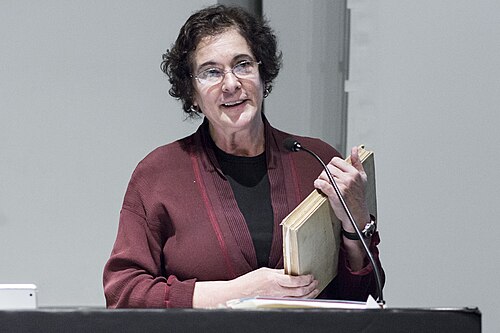
Lila Abu-Lughod
ليلى أبو لغد
Born: United States, United States
Domain: Academia & Thought
Recognition: Globally recognized
Member of the Palestinian diaspora
Biography
Lila Abu-Lughod was born in 1952 to the Palestinian political scientist Ibrahim Abu-Lughod and the American Jewish urban sociologist Janet Abu-Lughod, an inheritance that placed her at the intersection of cultures and disciplines from the start. She became a professor of anthropology and of women's and gender studies at Columbia University and one of the most influential anthropologists of her generation. Her early ethnographic work, especially Veiled Sentiments (1986), a study of poetry and emotion among Bedouin women in Egypt's Western Desert, became a classic of feminist anthropology. It demonstrated how women's oral poetry expressed sentiments at odds with the dominant moral code, and it reshaped scholarly understanding of gender, honor, and the politics of emotion. Writing Women's Worlds (1993) further challenged anthropology's tendency to generalize about "culture." Abu-Lughod's best-known intervention is her critique of the Western narrative of the oppressed Muslim woman who must be rescued. Her 2002 article and 2013 book, both titled Do Muslim Women Need Saving?, showed how that narrative has been used to justify military and political intervention in Muslim societies, and called instead for attention to women's own agency, voices, and circumstances. The work became central to debates over feminism, empire, and human rights. Across her career she has explored three linked questions: the relationship between cultural forms and power, the politics of knowledge and representation, and the dynamics of women's rights, global liberalism, and feminist governance in the Muslim world. She has also written on Palestine, including the question of memory and the Nakba, extending the engaged scholarly tradition of her father. A recipient of major honors in anthropology and a widely translated author, Abu-Lughod has shaped feminist theory, Middle East studies, and the anthropology of media and rights. Her insistence on listening to women rather than speaking for them has made her a defining voice against the instrumentalization of Muslim women's lives in Western political discourse.
Why This Person Matters
A leading feminist anthropologist, Abu-Lughod transformed how scholars study gender in the Middle East and her Do Muslim Women Need Saving? became a defining critique of using women's rights to justify empire.
Historical Context
Born in 1952 to the Palestinian political scientist Ibrahim Abu-Lughod and the American Jewish sociologist Janet Abu-Lughod, Lila Abu-Lughod was shaped from birth by an inheritance straddling cultures, faiths, and the politics of the Palestinian cause. She entered anthropology in the 1970s and 1980s as the discipline was being transformed by feminism and the critique of representation that her father's friend Edward Said helped ignite. Her best-known intervention emerged in the climate of the post-9/11 War on Terror, when the figure of the oppressed Muslim woman was being mobilized to justify Western military intervention in Afghanistan and beyond. Her scholarship has consistently engaged the politics of empire, knowledge, and the Palestinian question she inherited.
Historical Context
- — Born in United States, United States
- — Six-Day War and occupation of West Bank and Gaza
Legacy & Influence
Veiled Sentiments became a classic of feminist anthropology, transforming how scholars study gender, emotion, and honor in the Middle East. Her book and essay Do Muslim Women Need Saving? became a defining critique of how the rhetoric of women's rights is used to justify empire, central to debates over feminism, human rights, and intervention. Across her career she reshaped Middle East studies and the anthropology of media and rights, insisting that scholars listen to women rather than speak for them. A widely translated and honored author, she has extended her father's engaged scholarly tradition while becoming a leading voice against the instrumentalization of Muslim women's lives in Western political discourse.
Topics & Themes
- Nakba Generation
- Diaspora
References & Sources
- Lila Abu-Lughod — https://en.wikipedia.org/wiki/Lila_Abu-Lughod
- Lila Abu-Lughod | Columbia Department of Anthropology — https://anthropology.columbia.edu/content/lila-abu-lughod
- Do Muslim Women Need Saving? | Harvard University Press — https://www.hup.harvard.edu/books/9780674088269