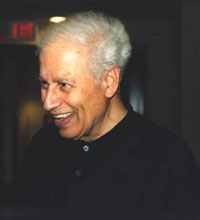
Hanna Batatu
حنا بطاطو
Born: Jerusalem, Mandatory Palestine
Domain: Academia & Thought
Recognition: Globally recognized
Member of the Palestinian diaspora
Biography
Hanna Batatu (1926–2000) was a Palestinian-American historian and political sociologist widely regarded as one of the most important scholars of the modern Arab world. Born into a Palestinian Arab Christian family in Jerusalem in 1926, he attended high school in the city and worked at a local post office before the upheavals of 1948 forced his family out of Palestine. He emigrated to the United States that year, an experience of dispossession that shaped his lifelong identity as, in the words of colleagues, "an unabashed Palestinian patriot" and informed his intellectual commitment to understanding the dispossessed and the structures of social power. In the United States Batatu pursued an austere and single-minded scholarly career. He studied at Georgetown University's Edmund A. Walsh School of Foreign Service from 1951 to 1953 and earned his doctorate in political science from Harvard University in 1960, with a dissertation titled "The Shaykh and the Peasant in Iraq, 1917–1958." From 1962 to 1982 he taught at the American University of Beirut, then returned to Georgetown University, where he taught from 1982 until his retirement in 1994. Across these decades he trained several generations of students, some of whom became leading figures in Arab intellectual and political life. Batatu's towering achievement is his encyclopedic three-volume study, The Old Social Classes and the Revolutionary Movements of Iraq (Princeton University Press, 1978), written over roughly two decades. Drawing on Ibn Khaldun, Marx, and Weber, it traces Iraq's landed and commercial classes, the rise of the Iraqi Communist Party, the Baʿthists and the Free Officers, and the 1958 revolution. The work rested on extraordinary primary research: from the late 1950s Batatu travelled repeatedly to Iraq, conducted in-depth interviews with imprisoned political dissidents, and gained access to secret police and security-service archives spanning the monarchy through the 1970s. Scholars have called it "the best, most detailed modern history of any Arab country," and an entire 1989 conference was devoted to its implications. His later major work, Syria's Peasantry, the Descendants of Its Lesser Rural Notables, and Their Politics (Princeton, 1999), applied the same rigorous class analysis to the social origins of the Baʿthist state in Syria, completing a remarkable scholarly arc. By temperament Batatu was famously shy and self-effacing, ill at ease in casual conversation yet relentless in interrogating acquaintances about their family history, ethnic roots, and social position—a living embodiment of his conviction that class relations lie at the heart of Middle Eastern society. Batatu died on June 24, 2000, in Winsted, Connecticut, at the age of seventy-four. He left behind no large body of disciples in the conventional sense, but a method and a monument: a way of reading Arab societies through their deepest social structures, and a book that remains, decades after publication, the indispensable foundation of modern Iraqi historiography.
Why This Person Matters
He wrote what scholars still call the finest modern history of any Arab country, fusing Marxist class analysis with unmatched archival research to redefine how the Arab world is understood.
Historical Context
Batatu belonged to the Palestinian generation whose lives were severed by the 1948 Nakba: born and raised in Mandate-era Jerusalem, he was a young man working in the city when his family was driven into exile in 1948. Unlike many compatriots who remained in the Arab refugee experience, he carried his displacement into the Western academy, becoming one of the most distinguished products of the Palestinian diaspora's intellectual flowering. His work never addressed Palestine directly, yet his lifelong preoccupation with dispossession, landed elites, and the social roots of revolution drew quietly on the rupture of his own origins.
Historical Context
- — Born in Jerusalem, Mandatory Palestine
- — The Nakba – Palestinian catastrophe and mass displacement
- — Six-Day War and occupation of West Bank and Gaza
- — Passed away at age 74
Legacy & Influence
More than four decades after its publication, The Old Social Classes and the Revolutionary Movements of Iraq remains the indispensable starting point for any serious study of modern Iraq, and Batatu's method—reading politics through deep social and class structures, grounded in exhaustive primary sources—continues to shape Middle East studies. He mentored several generations of students who carried his rigor into scholarship and Arab political life, and his name stands as a benchmark of intellectual integrity and empirical depth that later historians of the region still measure themselves against.
Topics & Themes
- British Mandate
- Diaspora
- Jerusalem
References & Sources
- Hanna Batatu — Wikipedia — https://en.wikipedia.org/wiki/Hanna_Batatu
- Hanna Batatu — Middle East Research and Information Project (MERIP) — https://www.merip.org/2000/09/hanna-batatu/
- The Old Social Classes and the Revolutionary Movements of Iraq — Internet Archive — https://archive.org/details/oldsocialclasses0000bata