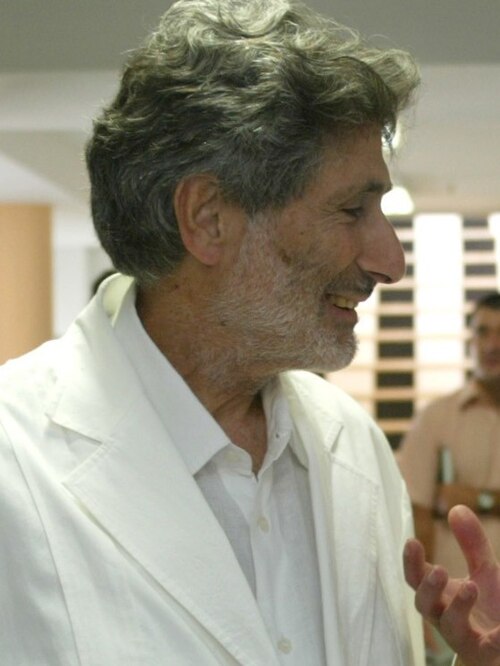
Edward Said
إدوارد سعيد
Born: Jerusalem, Mandatory Palestine
Domain: Academia & Thought
Recognition: Globally recognized
Member of the Palestinian diaspora
Biography
Edward Wadie Said was born in Jerusalem in 1935 into a prosperous Palestinian Christian family and grew up between Jerusalem and Cairo before attending boarding school in the United States. He earned his bachelor's degree at Princeton and his doctorate at Harvard, joining the faculty of Columbia University in 1963, where he would teach comparative literature for the rest of his life. A polymath equally at home in literary theory, music criticism, and political commentary, he became one of the most influential public intellectuals of the late twentieth century. His 1978 book Orientalism is among the most cited works in the modern humanities and effectively founded the field of postcolonial studies. In it, Said argued that Western scholarship on the East had long functioned not as objective inquiry but as a system of representation entangled with imperial power, producing a distorted and self-serving image of the "Orient" that justified domination. The book reshaped disciplines from literature and anthropology to history and area studies, and its core insight, that knowledge and power are inseparable, became foundational across the academy. Said was also the most prominent voice articulating the Palestinian cause to Western audiences. Works such as The Question of Palestine (1979), Covering Islam (1981), and After the Last Sky (1986) brought Palestinian experience and dispossession into mainstream intellectual debate. He served for years on the Palestinian National Council before resigning in 1993 in protest at what he saw as the flawed and capitulatory terms of the Oslo Accords, and he became an outspoken advocate of a single binational democratic state. Beyond his scholarship, Said embodied the ideal of the engaged intellectual, a theme he developed in his 1993 Reith Lectures, published as Representations of the Intellectual. He insisted that the intellectual's role was to speak truth to power and to remain an outsider, an amateur unbound by guild or government. He was also an accomplished pianist and, with conductor Daniel Barenboim, co-founded the West-Eastern Divan Orchestra, bringing together young Arab and Israeli musicians. Said lived for over a decade with leukemia, continuing to write prolifically until his death in New York in 2003. His memoir Out of Place (1999) won the New Yorker Book Award. Decades after his death he remains a touchstone for scholars of empire, culture, and identity worldwide, and a defining figure of Palestinian intellectual life.
Why This Person Matters
Said founded postcolonial studies with Orientalism and became the world's most influential interpreter of the Palestinian cause, embodying the engaged intellectual who speaks truth to power.
Historical Context
Said belonged to the Palestinian bourgeoisie of late-Mandate Jerusalem and Cairo, a world swept away by the 1948 Nakba, which dispersed his extended family and erased the comfortable Levantine milieu of his childhood. Coming of age in American academia during the Cold War and the rise of postwar Arab nationalism, he found his political voice after the 1967 war, when Israel's occupation of the West Bank, Gaza, and East Jerusalem made the Palestinian question newly urgent. He wrote from within the Western academy at the height of decolonization and the theory revolution of the 1970s, turning the tools of literary criticism against empire itself. His break with the Oslo process in 1993 reflected his refusal to accept what he saw as a managed, unjust settlement that ignored the rights of the refugees and the diaspora he embodied.
Historical Context
- — Born in Jerusalem, Mandatory Palestine
- — The Nakba – Palestinian catastrophe and mass displacement
- — Six-Day War and occupation of West Bank and Gaza
- — Passed away at age 67
Legacy & Influence
Orientalism became one of the most cited works in the modern humanities and effectively founded postcolonial studies, reshaping literature, anthropology, history, and area studies around the insight that knowledge and power are inseparable. Said is remembered as the archetypal engaged intellectual who spoke truth to power, a model invoked far beyond Middle East studies. His name endures in institutions and chairs, including Columbia's Edward Said Professorship of Modern Arab Studies, and in the West-Eastern Divan Orchestra he co-founded with Daniel Barenboim. Decades after his death he remains the single most influential interpreter of the Palestinian cause to global audiences and a touchstone for scholars of empire, culture, and identity worldwide.
Topics & Themes
- British Mandate
- Diaspora
- Jerusalem
References & Sources
- Edward Said — https://en.wikipedia.org/wiki/Edward_Said
- Edward Said | American Literary Critic & Philosopher — https://www.britannica.com/biography/Edward-Said
- Edward W. Said | Palquest — https://www.palquest.org/en/biography/16018/edward-w-said