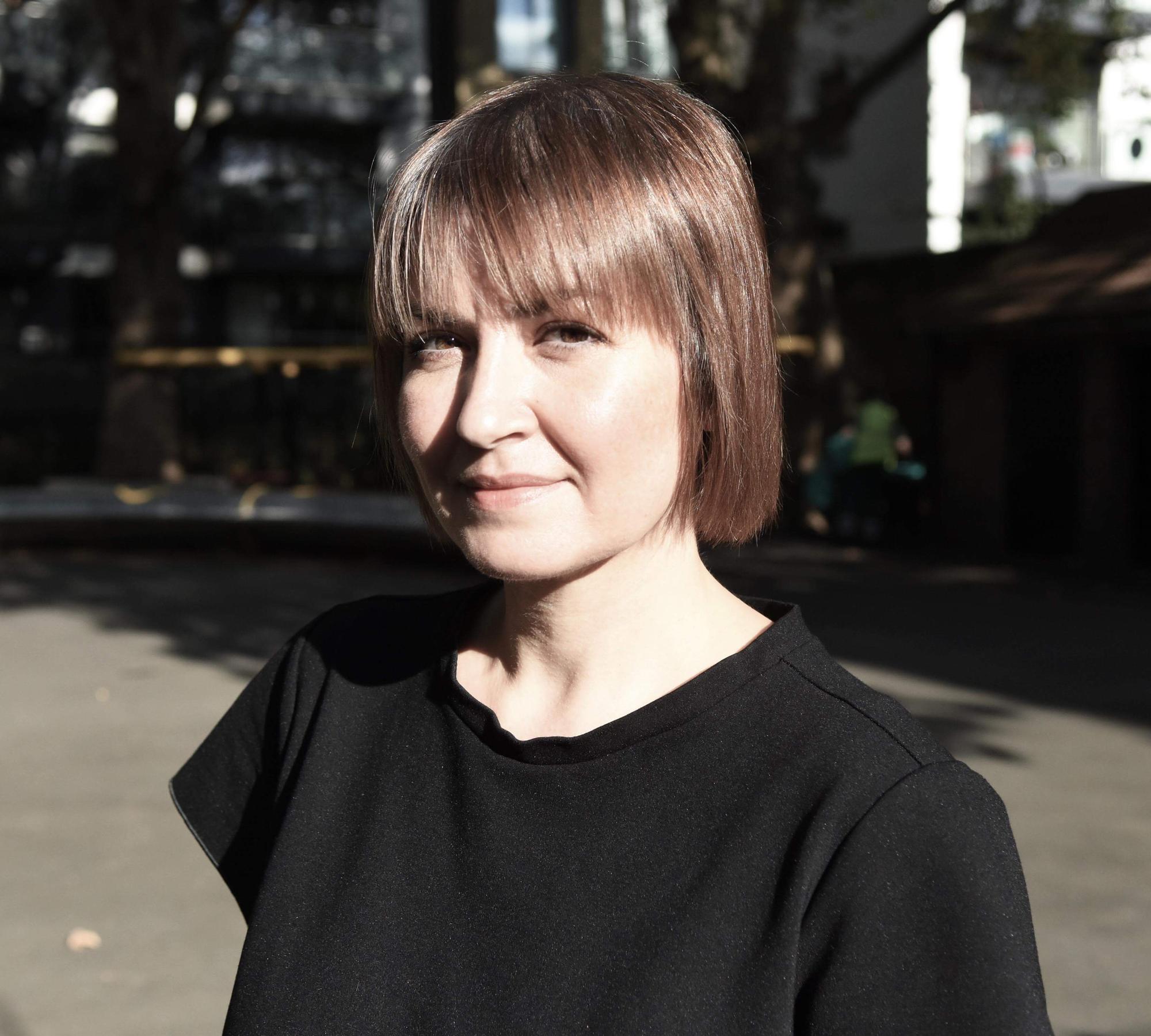
Larissa Sansour
لاريسا صنصور
Born: Jerusalem, Palestinian Territories
Domain: Visual Arts
Recognition: Globally recognized
Member of the Palestinian diaspora
Biography
Larissa Sansour (born 1973 in East Jerusalem) is a contemporary Palestinian artist who has become internationally known for using the visual language of science fiction to reframe the politics of Palestine. Born to a Palestinian father and a Russian mother and raised in Bethlehem, she trained at the Byam Shaw School of Art in London, earned a BFA from the Maryland Institute College of Art and an MA in fine art from New York University, and studied art history and criticism at the University of Baltimore before settling in London. Sansour works across film, photography, sculpture, and installation, but is best known for cinematic works that deploy the speculative and dystopian conventions of science fiction. This choice was strategic: rather than producing documentary depictions expected of a Middle Eastern woman artist, she uses futuristic allegory to explore occupation, displacement, memory, and national identity, generating fresh perspectives on otherwise familiar political realities. Her film 'Nation Estate' (2012) imagines a future in which Palestinians are confined to a single high-rise skyscraper, traveling between cities by elevator, hemmed in by Israeli watchtowers and the separation wall, a darkly satirical vision of statehood reduced to a building. The work attracted international attention, including controversy when it was implicated in a dispute over a photography prize, amplifying her visibility. Sansour's profile reached a new height when she was selected to represent Denmark at the 2019 Venice Biennale, where her installation 'Heirloom' centered on the film 'In Vitro,' a haunting two-channel work set in a post-apocalyptic bunker beneath Bethlehem that meditates on trauma, memory, and inheritance. Representing a European nation as a Palestinian artist at the world's most prominent art event was itself a notable statement. With exhibitions across Europe and beyond, including at venues such as Amos Rex in Helsinki, Sansour has established herself as one of the most distinctive voices in contemporary Palestinian art. By bringing speculative fiction into the discourse on Palestine, she has expanded the formal and conceptual vocabulary available to the next generation of artists.
Why This Person Matters
Sansour pioneered a science-fiction approach to Palestinian art and represented Denmark at the Venice Biennale, expanding how the Palestinian future can be imagined on the world stage.
Historical Context
Born in 1973 in East Jerusalem to a Palestinian father and a Russian mother and raised in Bethlehem, Larissa Sansour came of age as the separation wall and the architecture of fragmentation reshaped the West Bank she knew. Trained in London, Baltimore, and New York, she chose science fiction precisely as a refusal of the documentary realism expected of a Middle Eastern woman artist working under and after the Second Intifada. Her dystopian futures, a Palestine compressed into a single skyscraper in 'Nation Estate' (2012), a bunker beneath Bethlehem in 'In Vitro,' translate the lived realities of occupation, enclosure, and the wall into allegory. The work emerged in an era when the political horizon for Palestinians seemed to be narrowing into permanent confinement.
Historical Context
- — Born in Jerusalem, Palestinian Territories
Selected Works
- A Space Exodus — A 2009 video work riffing on Stanley Kubrick's 2001: A Space Odyssey in which a Palestinian astronaut becomes the first Palestinian on the moon, planting a Palestinian flag and radioing back 'This is one small step for a Palestinian, one giant leap for mankind.'
Legacy & Influence
Sansour pioneered a speculative, science-fiction register for Palestinian art that has expanded the formal vocabulary available to a younger generation of artists and filmmakers. Her selection to represent Denmark at the 2019 Venice Biennale, a Palestinian artist standing for a European nation at the art world's foremost event, was itself a landmark statement carried by her installation 'Heirloom.' Works like 'Nation Estate' and 'In Vitro' circulate internationally and are cited as proof that the Palestinian future, not only its past, can be imagined as art. By bringing dystopia and allegory into the discourse on Palestine, she opened a new path between politics and the imagination.
Topics & Themes
- Post-1967
- Diaspora
- Jerusalem
References & Sources
- Larissa Sansour - Wikipedia — https://en.wikipedia.org/wiki/Larissa_Sansour
- Larissa Sansour on Representing Palestine in the Danish Pavilion — https://www.thenationalnews.com/arts-culture/art/artist-larissa-sansour-on-representing-palestine-in-the-danish-pavilion-at-the-venice-biennale-1.869497
- Larissa Sansour Interview - Studio International — https://www.studiointernational.com/larissa-sansour-interview-danish-pavilion-venice-biennale-2019