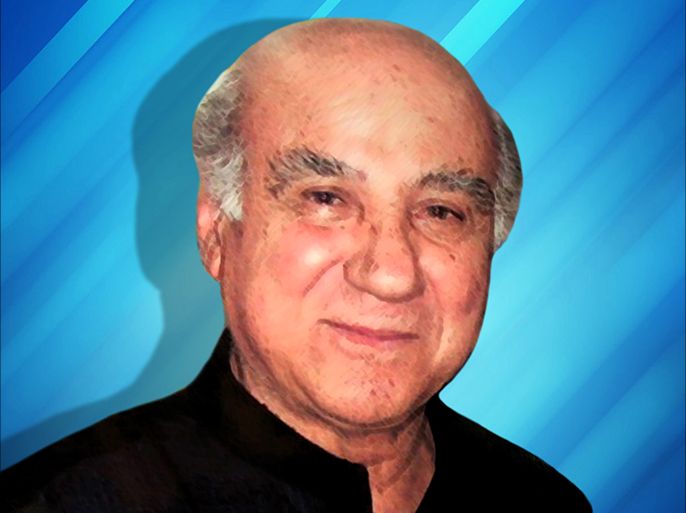
Ismail Shammout
إسماعيل شموط
Born: Lydda, Mandatory Palestine
Domain: Visual Arts
Recognition: Regionally recognized
Member of the Palestinian diaspora
Biography
Ismail Shammout (1930-2006), born in Lydda, is widely considered the founding father of contemporary Palestinian art. Spotted for his talent as a schoolboy, he was mentored by his teacher Daoud Zalatimo, who taught him drawing, watercolor, and limestone sculpture. The defining rupture of his life came in July 1948, when he and some 25,000 residents of Lydda were expelled during the Nakba; on the forced march toward Ramallah his young brother Tawfiq died of thirst, a trauma Shammout would later render in some of his most famous paintings. In 1950 Shammout traveled to Cairo to pursue art formally, working nights as an illustrator of Egyptian film posters while studying by day. Under Egyptian modernist instructors such as Hussein Bicar and Youssef Kamel, he developed an expressive figurative style that transformed his personal suffering into a shared national iconography. His 1953 exhibition in Gaza City, which included his celebrated painting 'Where to?' (Ila Ayn?), is regarded as the first contemporary art exhibition held in Palestine by a Palestinian artist on Palestinian soil. Shammout's realistic, symbolic, and lightly expressionist canvases became visual anchors of the Palestinian cause, picturing refugees, the journey of exile, longing for return, and the dignity of a dispossessed people. In 1959 he married fellow painter Tamam al-Akhal, beginning a lifelong artistic and personal partnership. Together their work shaped how Palestinians and the wider Arab world saw the catastrophe of 1948 and the aspiration to return. Beyond painting, Shammout was a foundational cultural organizer. He became director of the PLO's Department of Arts and National Culture in 1965, co-founded the General Union of Palestinian Artists in 1969 and served as its secretary-general, and helped found the General Union of Arab Artists in 1971. Political upheaval repeatedly forced him into exile, from Beirut to Kuwait, Germany, and finally Amman, where he settled in 1994. In his final years, Shammout and al-Akhal completed an ambitious cycle of nineteen large murals, 'Palestine: The Exodus and the Odyssey' (1997-2000), narrating the Palestinian experience since 1948 in chronological sequence. He died in 2006, leaving a body of work that remains among the most reproduced and emotionally resonant in Palestinian visual culture.
Why This Person Matters
Shammout is the founding father of contemporary Palestinian painting, whose images of exile and return became the visual language of the Palestinian cause.
Historical Context
Shammout's life was cleaved in two by the Nakba: in July 1948 he and some 25,000 residents of Lydda were expelled at gunpoint, and on the forced march toward Ramallah his young brother Tawfiq died of thirst, a trauma that would haunt his canvases for decades. He came of age artistically in 1950s Cairo, working nights painting Egyptian film posters while studying under modernist masters, just as Nasserist Arab nationalism was cresting and the Palestinian cause was being articulated as a regional and pan-Arab struggle. His 1953 Gaza exhibition unfolded in the refugee-saturated aftermath of dispossession, and his later career tracked the rise of the PLO and the repeated displacements of Palestinian institutions through Beirut, Kuwait, and exile. His art was inseparable from the political evolution of the national movement itself.
Historical Context
- — Born in Lydda, Mandatory Palestine
- — The Nakba – Palestinian catastrophe and mass displacement
- — Six-Day War and occupation of West Bank and Gaza
- — Passed away at age 76
Selected Works
- Where To? (Wain Nruh) — His defining 1953 work depicting Palestinian refugees in flight during the Nakba, rendered with anguished figures and desolate landscapes. A cornerstone of Palestinian visual culture and a symbol of the right of return.
- To Jerusalem! — A monumental 1961 painting expressing the collective Palestinian longing to return to Jerusalem, one of his most celebrated compositions expressing the enduring bond between people and holy city.
Legacy & Influence
Shammout is venerated as the founding father of contemporary Palestinian painting, and his images, refugees on the road of exile, the longing for return, the dignity of the dispossessed, became the very visual language of the Palestinian cause, reproduced more widely than almost any other body of Palestinian art. His 1953 Gaza show is regarded as the first contemporary art exhibition mounted by a Palestinian on Palestinian soil, and works like 'Where to?' remain canonical. As a cultural organizer he directed the PLO's Department of Arts and National Culture, co-founded the General Union of Palestinian Artists, and helped build the institutional scaffolding of Palestinian art. His final mural cycle with Tamam al-Akhal, 'Palestine: The Exodus and the Odyssey,' narrates the national experience since 1948 and stands as a summation of his life's mission.
Topics & Themes
- British Mandate
- Diaspora
References & Sources
- Ismail Shammout - Wikipedia — https://en.wikipedia.org/wiki/Ismail_Shammout
- Ismail Shammout - Palestinian Journeys / Palquest — https://www.palquest.org/en/biography/9727/ismail-shammout
- Ismail Shammout - Dalloul Art Foundation — https://dafbeirut.org/artists/ismail-shammout