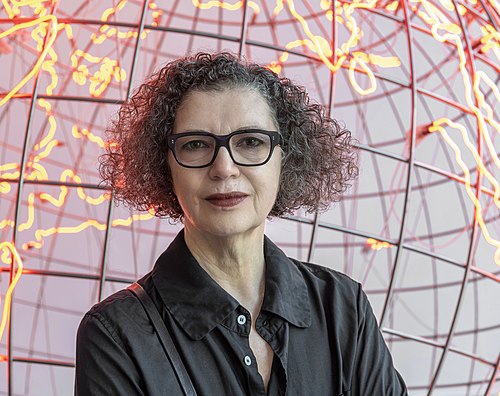
Mona Hatoum
منى حاطوم
Born: Beirut, Lebanon
Domain: Visual Arts
Recognition: Globally recognized
Member of the Palestinian diaspora
Biography
Mona Hatoum (born 1952 in Beirut) is among the most internationally acclaimed artists of Palestinian heritage and one of the leading conceptual artists of her generation worldwide. Born to Palestinian parents from Haifa who had been displaced to Lebanon, she was ineligible for Lebanese citizenship and grew up with a profound sense of statelessness that would shape the themes of dislocation, exile, and belonging that run through her work. Her exile became literal and permanent in 1975: on a short visit to London, the outbreak of the Lebanese Civil War prevented her return, and she remained in Britain, training at the Byam Shaw School of Art and the Slade School of Fine Art between 1975 and 1981. London became her base, and she developed into a major figure in the international art world while continuing to grapple with the condition of displacement. Hatoum first gained attention through performance and video in the 1980s. Her breakthrough work, 'Measures of Distance' (1988), is a fifteen-minute video in which images of her mother showering are overlaid with the artist reading her mother's letters from war-torn Beirut, a tender and searing meditation on separation, intimacy, and the Palestinian diaspora. She later turned to large-scale installation and sculpture, transforming ordinary domestic objects, beds, kitchen utensils, cages, maps, into uncanny, often menacing forms that evoke surveillance, danger, and the precariousness of home. In 1995 Hatoum was nominated for the prestigious Turner Prize, a landmark moment of recognition. She has since held major solo exhibitions at institutions including the Tate Modern in London, the Centre Pompidou in Paris, and the New Museum in New York, and her work is held in the world's foremost public collections. Her installations are studied internationally as touchstones of post-minimalist and politically charged contemporary art. Though her work rarely addresses Palestine in explicitly literal terms, Hatoum's entire practice is animated by the experience of exile and the unstable meaning of home, making her one of the most significant globally recognized artists to emerge from the Palestinian diaspora. She stands as proof that the Palestinian experience can resonate at the very center of world contemporary art.
Why This Person Matters
A Turner Prize nominee with works in the Tate and Pompidou, Hatoum is the most globally celebrated artist of Palestinian heritage, making exile a language of world contemporary art.
Historical Context
Mona Hatoum was born in 1952 in Beirut to Palestinian parents displaced from Haifa in 1948, and grew up legally stateless, ineligible for Lebanese citizenship, a condition that seeded the themes of belonging and dispossession in her work. Her own exile became permanent by accident in 1975, when the outbreak of the Lebanese Civil War stranded her in London during a brief visit and she could not return. She trained at the Byam Shaw and the Slade through the late 1970s, emerging as an artist whose biography was inseparable from the larger Palestinian and Lebanese ruptures of her century. Her 1988 'Measures of Distance,' built from her mother's letters out of war-torn Beirut, drew this history directly into the body of her art.
Historical Context
- — Born in Beirut, Lebanon
- — Six-Day War and occupation of West Bank and Gaza
Selected Works
- Map — A world map rendered in glass marbles that roll and shift underfoot, making the viewer complicit in destabilising global geography. Held in major museum collections worldwide.
- Present Tense — A large-scale floor installation using 2,200 bars of Nablus soap embedded with red glass beads tracing the fragmented maps of the Oslo Accords, implicating the body itself in the geography of dispossession.
Legacy & Influence
Hatoum is the most globally celebrated artist of Palestinian heritage, her 1995 Turner Prize nomination and major solo shows at Tate Modern, the Centre Pompidou, and the New Museum marking a permanent place at the center of world contemporary art. Her uncanny domestic objects, cages, beds, and electrified kitchens, are studied internationally as defining works of politically charged post-minimalism. By making statelessness and the instability of home into a universal visual language, she proved the Palestinian experience could speak from the very heart of the global canon. Generations of younger Arab and diaspora artists invoke her as the demonstration that exile can be rendered as rigorous, world-class form.
Topics & Themes
- Nakba Generation
- Diaspora
References & Sources
- Mona Hatoum - Wikipedia — https://en.wikipedia.org/wiki/Mona_Hatoum
- Mona Hatoum - Tate — https://www.tate.org.uk/art/artists/mona-hatoum-2365
- Turner Prize 1995 Artists: Mona Hatoum — https://www.tate.org.uk/whats-on/tate-britain/turner-prize-1995/turner-prize-1995-artists-mona-hatoum