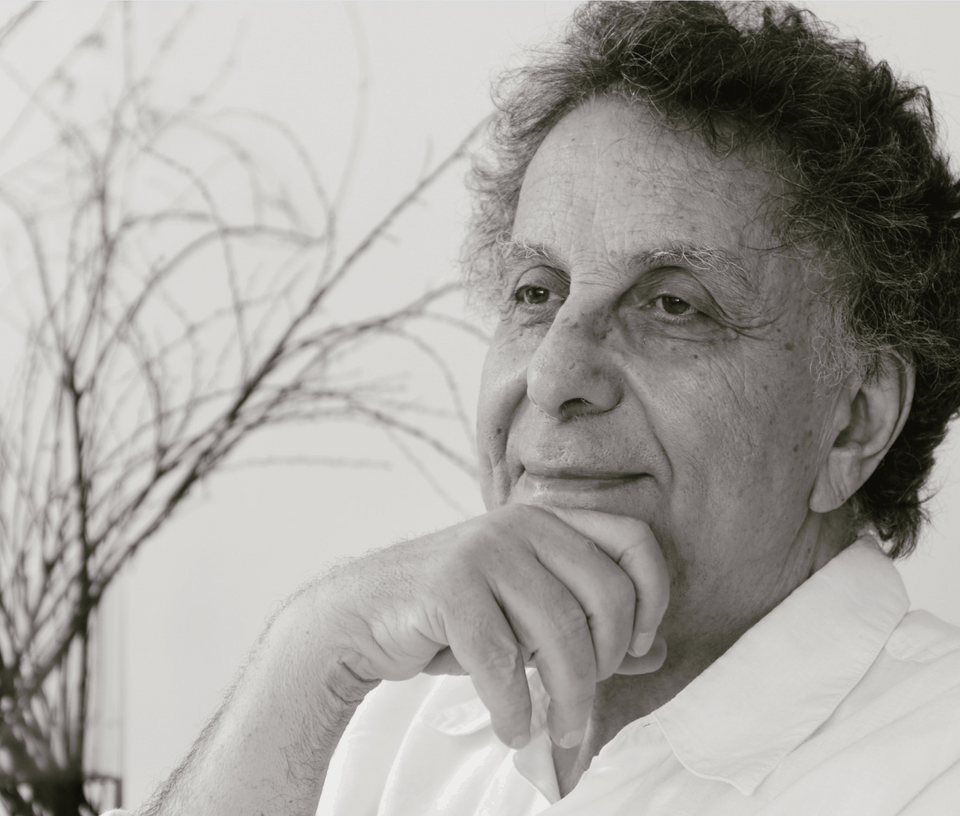
Kamal Boullata
كمال بُلّاطة
Born: Jerusalem, Mandatory Palestine
Domain: Visual Arts
Recognition: Globally recognized
Member of the Palestinian diaspora
Biography
Kamal Boullata (1942-2019) was a Palestinian abstract artist and art historian born in the Christian Quarter of Jerusalem, whose work fused the geometry and calligraphy of his native city with a rigorously modern abstract sensibility. As a boy he sketched the geometric patterns of the Dome of the Rock for hours and apprenticed during summers in the workshop of the renowned Jerusalemite icon painter Khalil Halaby, an early grounding in both Islamic ornament and Christian iconography that would underlie his entire career. Boullata studied at the Fine Arts Academy in Rome, graduating in 1965, and later earned an MFA from the Corcoran School of the Arts and Design in Washington, D.C., in 1971. When the 1967 war broke out he was abroad, and he was never able to return to live in Jerusalem; the rest of his life became, in his own framing, an effort to recapture the city through his art. This experience of exile and loss of place became the central theme of his abstract compositions. Working primarily in acrylic and silkscreen, Boullata built luminous geometric works that often integrated Arabic words and calligraphic forms, placing him within the wider Hurufiyya movement that drew on the letter as a plastic element. His abstraction was never merely formal: the divisions, mirrorings, and symmetries in his work encode ideas of fracture in Palestinian identity and the separation from homeland, turning pure geometry into a language of exile. Boullata was equally significant as a scholar and writer. He authored what is widely regarded as the most important survey of the field, 'Palestinian Art: From 1850 to the Present,' a foundational text that gave the art of Palestine a coherent historical narrative. His critical and curatorial work helped establish Palestinian art as a serious subject of study internationally. Living in exile across the United States, France, and Germany for more than five decades, Boullata achieved global recognition while remaining intensely focused on Jerusalem. After his death in 2019 he was buried in the city of his birth, returning at last to the place that had animated his life's work. He remains a central figure linking abstraction, calligraphy, scholarship, and the Palestinian condition.
Why This Person Matters
Boullata transformed Jerusalem's geometry and Arabic letterforms into world-class abstraction, and his scholarship gave Palestinian art its definitive history.
Historical Context
Born in 1942 in the Christian Quarter of Jerusalem, Kamal Boullata absorbed the Dome of the Rock's geometry and the icon-painting workshop of Khalil Halaby as a child in a still-undivided city. The 1967 war caught him studying in Rome, and he was never permitted to return to live in Jerusalem, an exile that became the governing condition of his entire life and art. He spent more than five decades moving between Washington, France, and Germany, carrying the lost city with him as both subject and wound. His abstraction matured alongside the Hurufiyya movement of the 1960s and 70s, in which Arab modernists reclaimed the Arabic letter as a plastic form, but for Boullata its symmetries always encoded the fracture of dispossession.
Historical Context
- — Born in Jerusalem, Mandatory Palestine
- — The Nakba – Palestinian catastrophe and mass displacement
- — Six-Day War and occupation of West Bank and Gaza
- — Passed away at age 77
Selected Works
- Geometric Calligraphic Paintings — Boullata's signature works transform Arabic letters and Quranic verses into bold optical-art geometry — grids, circles, and lattices that simultaneously perform the spiritual and the political, held in major collections worldwide.
Legacy & Influence
Boullata gave Palestinian art both a body of luminous geometric abstraction and its first coherent history: his survey 'Palestinian Art: From 1850 to the Present' remains the field's foundational text. His silkscreens and acrylics, which fold Arabic calligraphy into mirrored geometric structures, are held in international collections and read as a visual grammar of exile. As a critic, curator, and scholar he helped install Palestinian art as a serious international subject rather than a regional footnote. His 2019 burial in the Jerusalem of his birth, after a lifetime barred from returning, has become a resonant emblem of the Palestinian longing for homecoming, and his writing continues to anchor scholarship in the field.
Topics & Themes
- British Mandate
- Diaspora
- Jerusalem
References & Sources
- Kamal Boullata - Wikipedia — https://en.wikipedia.org/wiki/Kamal_Boullata
- Kamal Boullata - Jerusalem Story — https://www.jerusalemstory.com/en/bio/kamal-boullata
- Kamal Boullata Buried in Jerusalem After 50 Years of Exile — https://www.middleeasteye.net/news/palestinian-artist-kamal-boullata-be-buried-jerusalem-after-50-years-forced-exile