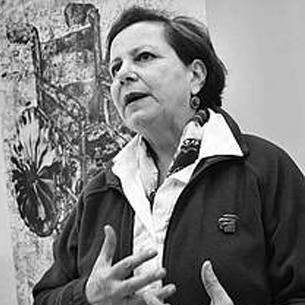
Vera Tamari
فيرا تماري
Born: Jerusalem, Mandatory Palestine
Domain: Visual Arts
Recognition: Regionally recognized
Biography
Vera Tamari (born 1945 in Jerusalem) is a pioneering Palestinian ceramicist, installation artist, art historian, and institution-builder whose multifaceted career has shaped both the making and the study of art in Palestine. Born into a Palestinian Christian family originally from Jaffa, she studied fine art at the Beirut College for Women, ceramics at the National Institute of Art in Florence, and Islamic art and architecture at Oxford University, an unusually broad formation that informs the depth of her practice. In 1975 Tamari became the first artist to establish a ceramics studio in the West Bank, opening one in al-Bira near Ramallah and effectively introducing studio ceramics as a serious contemporary art form in Palestine. Her bas-relief clay panels, including the 'Family Portraits' series of the late 1980s and 1990s, translate Palestinian domestic life and collective memory into a tactile, intimate visual language rooted in the materiality of earth. Tamari is among the most intellectually significant of her generation, having served for more than two decades as a professor of Islamic art, architecture, and art history at Birzeit University, where she founded and directed both the Virtual Gallery and the Birzeit University Museum between 2005 and 2010. Through this work she helped create the scholarly and curatorial infrastructure that contemporary Palestinian art needs to document and preserve itself. A founding member of the League of Palestinian Artists in 1973 and of the New Visions group in 1987, Tamari has consistently linked artistic innovation to collective and political engagement. Her best-known installation, 'Going for a Ride?' (2002), assembled cars crushed by Israeli tanks during the invasion of Ramallah and displayed them on a tarmac beside a soccer field, a defiant act of public art under occupation. Her 'Tale of a Tree' (2002), an installation of small ceramic olive trees, similarly transformed the trauma of incursion into a meditation on rootedness. As ceramicist, conceptual artist, scholar, curator, and community activist working under occupation, Tamari embodies a uniquely integrated model of the engaged artist. Her contribution lies not only in her own objects but in the durable institutions and intellectual frameworks she built for Palestinian art.
Why This Person Matters
Tamari pioneered studio ceramics and conceptual installation in Palestine while building the museums and scholarship that preserve Palestinian art.
Historical Context
Vera Tamari was born in 1945 in Jerusalem into a Christian family originally from Jaffa, three years before the Nakba scattered her city's communities and severed the coastal world her family belonged to. She came of age across the displaced Palestinian intelligentsia of Beirut, then trained in Florence and Oxford during the 1960s and 70s, returning to a West Bank already under Israeli military occupation after 1967. Her decision to plant a ceramics studio in al-Bira in 1975 was itself a wager on cultural rootedness at a moment when Palestinian institutions barely existed. The Second Intifada and the 2002 Israeli reinvasion of Ramallah, which she lived through directly, turned her studio practice toward defiant public art made from the wreckage of occupation.
Historical Context
- — Born in Jerusalem, Mandatory Palestine
- — The Nakba – Palestinian catastrophe and mass displacement
- — Six-Day War and occupation of West Bank and Gaza
Selected Works
- Gaza-Jericho (First Intifada Ceramics) — Tamari's ceramic installations documented and responded to the First Intifada, using the ancient Palestinian craft of pottery as a medium of resistance — a body of work that made her one of the most significant voices of Palestinian women's art.
Legacy & Influence
Tamari is remembered as the figure who introduced studio ceramics to Palestine and built much of the scholarly scaffolding that lets Palestinian art preserve itself. The Birzeit University Museum and Virtual Gallery she founded and directed remain working institutions, and her 'Family Portraits' reliefs and the 2002 installation 'Going for a Ride?' are touchstones cited whenever the history of Palestinian conceptual art is written. As a founding member of the League of Palestinian Artists and the New Visions group, she helped define a tradition of art bound to collective struggle. Her dual legacy as maker and museum-builder continues to shape how younger Palestinian artists understand both their craft and their responsibility to document it.
Topics & Themes
- British Mandate
- Jerusalem
References & Sources
- Vera Tamari - Wikipedia — https://en.wikipedia.org/wiki/Vera_Tamari
- Vera Tamari's Lifetime of Palestinian Art — https://themarkaz.org/vera-tamaris-lifetime-of-palestinian-art/
- Tamari, Vera (1945-) - Encyclopedia.com — https://www.encyclopedia.com/international/encyclopedias-almanacs-transcripts-and-maps/tamari-vera-1945