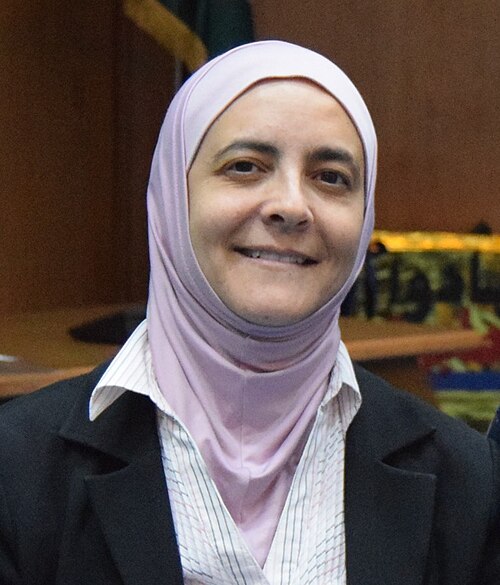
Rana Dajani
رنا الدجاني
Born: Amman, Jordan
Domain: Science & Medicine
Recognition: Globally recognized
Member of the Palestinian diaspora
Biography
Rana Dajani is a molecular biologist of Palestinian heritage and one of the most internationally recognized Arab women scientists of her generation. Of Palestinian and Syrian descent and holding a Jordanian passport, she describes herself as half-Palestinian, with her father's family rooted in Palestine. She earned her doctorate in molecular and cellular biology and became a tenured professor of biology and biotechnology at the Hashemite University in Jordan. Dajani's research focuses on the genetics of populations in the region, including genome-wide association studies of diabetes and cancer, and on stem-cell biology. Her work establishing the genetic profiles of Circassian and Chechen communities in Jordan, and her studies of the biological effects of trauma on refugees, have made significant contributions to understanding both regional human genetics and the embodied consequences of displacement and stress. A notable institution-builder, Dajani led the development of Jordan's stem cell research ethics law and its regulatory framework, helping create one of the most progressive legal environments for stem cell science in the Muslim world. She has held visiting appointments and fellowships at Yale, Harvard's Radcliffe Institute, and Cambridge, and has been repeatedly named among the world's most influential Muslim and Arab women scientists. Beyond the laboratory, she is a passionate advocate for women and minorities in science and for science education, and is the founder of 'We Love Reading,' an internationally replicated grassroots literacy program that has trained tens of thousands of volunteers to foster reading among children across dozens of countries. Dajani exemplifies a modern Palestinian-Arab scientist whose impact spans cutting-edge genetics, science policy, and social entrepreneurship, and who has used her global platform to expand opportunity for the next generation of researchers in the Arab world.
Why This Person Matters
One of the Arab world's most recognized women scientists, Dajani advanced regional human genetics, wrote Jordan's stem-cell ethics law, and built a global literacy movement.
Historical Context
Of Palestinian and Syrian descent and born in Amman in 1970, Dajani belongs to the Palestinian diaspora whose roots, on her father's side, lie in Palestine. She built her scientific life in Jordan, home to one of the largest Palestinian refugee populations, where questions of displacement, trauma, and the genetics of regional communities were not abstractions but lived realities. Her career rose during the genomic revolution of the early twenty-first century, and her studies of trauma's biological imprint on refugees connected cutting-edge molecular biology to the human consequences of the region's conflicts. She emerged as one of the Arab world's most recognized women scientists during a period of growing attention to women's role in science.
Historical Context
- — Born in Amman, Jordan
Legacy & Influence
Dajani's genetic research on regional populations, including the Circassian and Chechen communities of Jordan and the biology of trauma in refugees, advanced understanding of both human genetics and the embodied consequences of displacement. She authored Jordan's stem-cell research ethics law, creating one of the most progressive regulatory frameworks for the field in the Muslim world. Repeatedly named among the world's most influential Muslim and Arab women scientists, she founded 'We Love Reading,' a grassroots literacy movement replicated in dozens of countries that has trained tens of thousands of volunteers. Her legacy spans frontier genetics, science policy, and social entrepreneurship in service of the next generation.
Topics & Themes
- Post-1967
- Diaspora
References & Sources
- Rana Dajani — https://en.wikipedia.org/wiki/Rana_Dajani
- Rana Dajani - Radcliffe Institute, Harvard — https://www.radcliffe.harvard.edu/people/rana-dajani
- I'm a Palestinian scientist building a more inclusive future — https://www.nature.com/articles/d41586-024-02509-z