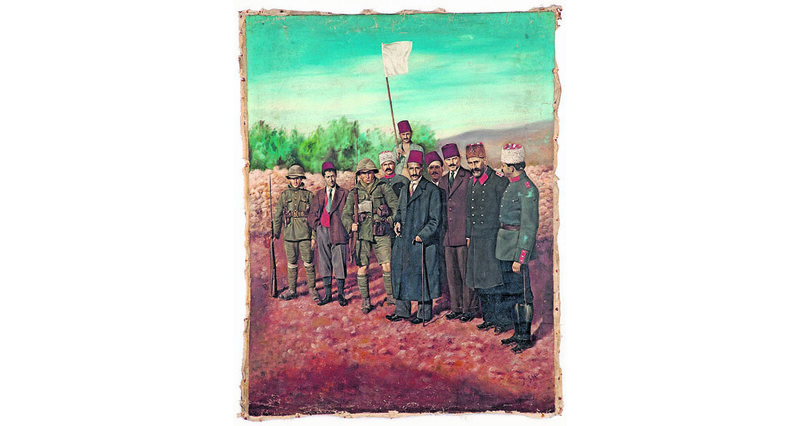
Nicola Saig
نقولا الصايغ
Born: Jerusalem, Ottoman Palestine
Domain: Visual Arts
Recognition: Regionally recognized
Biography
Nicola Saig (1863-1942) was a Jerusalem-born painter and iconographer widely regarded as one of the earliest pioneers of modern Palestinian art. Trained in the Greek Orthodox tradition of Byzantine icon painting and the distinctive Jerusalem workshop practices of his predecessors, Saig began his career producing devotional images before gradually transforming his practice into something unprecedented among local artists of his time. Around the turn of the twentieth century, Saig moved beyond strictly religious iconography to explore secular genres including landscapes, portraits, and still life. This shift marked a decisive break with centuries of inherited convention and positioned him as a transitional figure between the sacred craft of icon painting and the emergence of a modern, individual artistic vision in Palestine. He worked from an atelier near the Church of the Holy Sepulchre in the Old City of Jerusalem, where he exhibited and sold paintings to both the local community and international visitors. Saig was among the first Palestinian painters to engage seriously with photography, frequently copying hand-colored photographs as the basis for his early oil paintings. His most celebrated work, the 'Surrender of Jerusalem' (completed around 1917), was based on a photograph of the city's surrender to British forces and demonstrated that he could move fluidly between religious iconography and a modern, realistic depiction of contemporary events. The painting is considered a turning point in his career and a landmark in early Palestinian painting. Beyond his own production, Saig was an influential teacher who drew young apprentices to his studio and trained a new generation of Palestinian artists, including Tawfiq Jawhariyyeh, Zulfa al-Sa'di, and Daoud Zalatimo, the latter of whom would in turn mentor Ismail Shammout. Through this lineage, Saig's influence reached deep into the twentieth century and the formation of contemporary Palestinian art. Working in the late Ottoman and early Mandate periods, Saig embodies the moment when Palestinian visual culture began to develop a distinct, modern, and self-conscious artistic identity rooted in Jerusalem. His career bridges the worlds of liturgical craft, photographic seeing, and easel painting, making him a foundational reference point for any history of art in Palestine.
Why This Person Matters
Saig was among the first to turn Palestinian icon painting into modern secular art, and through his students he seeded the lineage that produced contemporary Palestinian painting.
Historical Context
Saig worked in Jerusalem across the twilight of Ottoman Palestine and the onset of British rule, a period when the holy city was a cosmopolitan crossroads of pilgrims, photographers, and competing imperial interests. Trained in the Greek Orthodox tradition of Byzantine icon painting in the workshops near the Church of the Holy Sepulchre, he inherited a craft centuries old just as new technologies, especially photography, were transforming how images were made and seen. His celebrated 'Surrender of Jerusalem' (c. 1917) was based on a photograph of the city's handover to British forces under Allenby, anchoring his art directly in the pivotal moment when Ottoman Palestine became Mandate Palestine. He thus stood precisely at the hinge between a sacred, liturgical visual culture and a modern, secular, event-conscious one.
Historical Context
- — Born in Jerusalem, Ottoman Palestine
- — The Nakba – Palestinian catastrophe and mass displacement
- — Six-Day War and occupation of West Bank and Gaza
- — Passed away
Selected Works
- Jerusalem Orientalist Paintings — A self-taught Palestinian painter who developed a celebrated style of Jerusalem scenes in the early 20th century, whose detailed depictions of the city's holy sites and daily life became prized collectors' items internationally.
Legacy & Influence
Saig is remembered as one of the earliest pioneers of modern Palestinian art, the figure who carried local painting beyond devotional iconography into secular landscapes, portraits, and depictions of contemporary events. His decisive influence flowed through his studio, where he trained a generation of apprentices including Tawfiq Jawhariyyeh, Zulfa al-Sa'di, and Daoud Zalatimo, the last of whom mentored Ismail Shammout, founder of contemporary Palestinian painting. Through this lineage Saig stands at the root of the family tree of modern Palestinian art. Historians of Palestinian visual culture treat him as a foundational reference point, the Jerusalem master in whom liturgical craft, photographic seeing, and easel painting first converged.
Topics & Themes
- Ottoman Era
- Jerusalem
References & Sources
- Before Painting: Nicola Saig, Painting, and Photographic Seeing — https://www.palestine-studies.org/en/node/1656916
- Nicola Saig - Biography and Works — https://www.artsy.net/artist/nicola-saig
- Nicola Saig at Darat al Funun — https://daratalfunun.org/?artist=nicola-saig