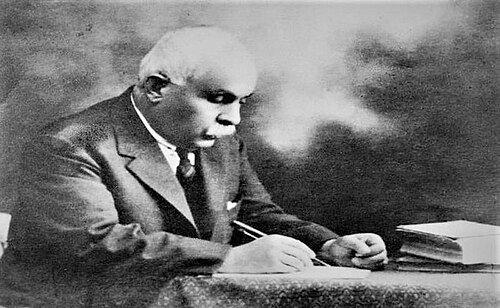
Najib Nassar
نجيب نصّار
Born: Ein Anoub, Ottoman Lebanon
Domain: Journalism & Media
Recognition: Regionally recognized
Biography
Najib Nassar (1865-1948) was a pioneering Palestinian journalist, editor, and political thinker, best known as the founder and editor of the Haifa weekly Al-Karmil. Born in the village of Ein Anoub in Mount Lebanon to a Greek Orthodox family, he settled in Palestine and became one of the earliest and most prescient analysts of the Zionist movement, dedicating his career to alerting Arab society to its implications. In December 1908, in the wake of the Young Turk revolution and the new climate of press freedom, Nassar founded Al-Karmil, the first explicitly anti-Zionist Arabic weekly in Palestine. Almost immediately the paper became the primary vehicle of a sustained campaign against land sales and Zionist colonization, combining investigative reporting with political argument. Nassar's editorials urged Ottoman authorities and Arab notables to recognize the demographic and economic transformation underway. In 1911 Nassar published al-Sihyuniyya (Zionism: Its History, Objective and Importance), the first Arabic-language book devoted to the subject, much of it adapted from the Jewish Encyclopaedia. This work established him as the Arab world's earliest serious student of Zionism and remains a landmark in the intellectual history of the Palestinian national movement. Nassar's activism carried a heavy price. He was a prominent figure in the political opposition during the final years of Ottoman rule, and in 1915-1918 he was hunted by Ottoman authorities and eventually imprisoned in Damascus during the wartime crackdown on Arab nationalists, a flight he later chronicled. Under the British Mandate he continued to publish, facing repeated suspensions for his criticism of both colonial policy and Zionist settlement. Dying in 1948 as the catastrophe he had long warned against unfolded, Nassar left a legacy as the founder of political journalism in Palestine. Al-Karmil and his writings shaped a generation of nationalist thought, and he is remembered as a journalist whose analytical foresight was decades ahead of his contemporaries.
Why This Person Matters
He founded Palestine's first anti-Zionist newspaper and wrote the first Arabic book on Zionism, pioneering political journalism in the country decades before its dangers were widely understood.
Historical Context
Najib Nassar, born in 1865 to a Greek Orthodox family in Mount Lebanon, settled in Palestine and founded the Haifa weekly Al-Karmil in December 1908, seizing the new press freedoms that followed the Young Turk revolution. Among the earliest Arabs to grasp the implications of Zionist colonization, he made his paper the first explicitly anti-Zionist Arabic weekly, campaigning against land sales and warning a still-complacent society of the transformation underway. His outspokenness drew the wrath of the Ottoman authorities, who hunted him during the wartime crackdown on Arab nationalists between 1915 and 1918, forcing him into a long fugitive flight before imprisonment in Damascus. Under the British Mandate he kept publishing despite repeated suspensions, dying in 1948 just as the catastrophe he had foreseen for four decades engulfed his homeland.
Historical Context
- — Born in Ein Anoub, Ottoman Lebanon
- — The Nakba – Palestinian catastrophe and mass displacement
- — Six-Day War and occupation of West Bank and Gaza
- — Passed away at age 83
Legacy & Influence
Nassar is remembered as the founder of political journalism in Palestine, having launched its first anti-Zionist newspaper and, in 1911, written al-Sihyuniyya, the first Arabic-language book on Zionism, a landmark in the intellectual history of the Palestinian national movement. Al-Karmil and his writings shaped a generation of nationalist thought and pressed Arab notables and Ottoman officials to confront a danger few yet recognized. His analytical foresight, decades ahead of his contemporaries, made him a prophetic figure whose warnings were vindicated by the very Nakba in which he died. He stands as a model of the journalist-intellectual who treats reporting as a form of political analysis and national defense.
Topics & Themes
- Ottoman Era
References & Sources
- Najib Nassar — https://en.wikipedia.org/wiki/Najib_Nassar
- Najib Nassar - Palquest — https://www.palquest.org/en/biography/6570/najib-nassar
- Al-Karmil newspaper — https://en.wikipedia.org/wiki/Al-Karmil_(newspaper)