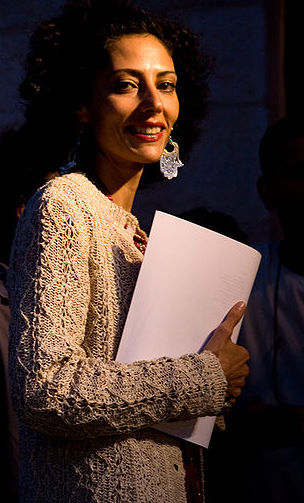
Suheir Hammad
سهير حمّاد
Born: Amman, Jordan
Domain: Literature & Poetry
Recognition: Globally recognized
Member of the Palestinian diaspora
Biography
Suheir Hammad (born 25 October 1973) is a Palestinian American poet, performer, and political activist whose work fuses the cadences of Brooklyn hip-hop with the memory of Palestinian dispossession. She was born in Amman, Jordan, to Palestinian refugee parents whose family had been expelled from Lydda (al-Lidd) during the 1948 Nakba and who, after years in the Gaza Strip and Jordan, immigrated to Brooklyn, New York, when she was five. Growing up in the working-class neighborhood of Sunset Park, Hammad absorbed both the spoken stories of her grandparents' lost homeland and the rhythms of the city's emerging hip-hop culture, a double inheritance that would define her voice. Hammad emerged in the mid-1990s while studying at Hunter College, publishing two books simultaneously in 1996: the lyrical prose memoir Drops of This Story and the poetry collection Born Palestinian, Born Black, whose title declared a solidarity between Palestinian and Black experience drawn from the Audre Lorde and June Jordan tradition. Her breakthrough into a mass audience came after the attacks of 11 September 2001, when she wrote First Writing Since, a poem of grief, anti-war conscience, and refusal of collective blame that circulated to tens of thousands of readers online. The piece brought her to the attention of Russell Simmons, who featured her on HBO's Def Poetry Jam and in the stage production Russell Simmons Presents Def Poetry Jam on Broadway. Her body of work spans page and stage. In addition to her two 1996 debuts, she published the spoken-word collection ZaatarDiva (2005) and Breaking Poems (2008), a formally adventurous volume that won a 2009 American Book Award and the 2009 Arab American Book Award for poetry. As a founding cast member of the Broadway production she shared in its 2003 Tony Award for Special Theatrical Event. In 2008 she made her acting debut as Soraya, an American-born Palestinian returning to her family's lost homeland, in Annemarie Jacir's feature Salt of This Sea, the first feature directed by a Palestinian woman, which screened in the Un Certain Regard section at the Cannes Film Festival. Across spoken word, the printed page, and film, Hammad has insisted on poetry as testimony and on the body as a site of both wounding and survival. Her honors include the Emerging Artist Award from NYU's Asian/Pacific/American Studies Institute (2001), the Morris Center for Healing Poetry Award (1996), and the Audre Lorde Writing Award at Hunter College. A widely seen TED speaker and a fixture on international stages, she has carried Palestinian narrative into venues far beyond the Arab world while remaining anchored in the diasporic, multiethnic milieu of Brooklyn that shaped her. Hammad continues to write, perform, and teach, mentoring younger poets and lending her voice to movements for Palestinian rights and against war. Her career embodies a generation of Arab American artists who refused to choose between artistic experiment and political commitment, treating the two as inseparable.
Why This Person Matters
She turned the spoken-word stage into a global megaphone for Palestinian memory, proving that diaspora poetry could be both fiercely political and artistically uncompromising.
Historical Context
Hammad belongs to the generation of the Palestinian diaspora born to families uprooted in the 1948 Nakba. Her grandparents were expelled from Lydda, one of the towns emptied during that year's mass expulsions, and her parents passed through Gaza and Jordan before settling in the United States. She came of age in the 1980s and 1990s in Brooklyn, where the Palestinian cause intersected with Black and immigrant struggles, and her work crystallized in the years around the Second Intifada and the post-9/11 backlash against Arabs and Muslims in America, a moment that gave her testimonial poetry its urgency and its mass audience.
Historical Context
- — Born in Amman, Jordan
Selected Works
- Born Palestinian, Born Black — Her debut 1996 collection, written in performance poetry style, forges solidarity between Palestinian and Black American experiences of dispossession, making her a bridge between two liberation traditions.
Legacy & Influence
Hammad helped make Palestinian poetry legible to a generation of English-speaking, performance-oriented audiences, influencing a wave of younger Arab American and diasporic spoken-word artists who followed her into slam stages, classrooms, and film. Her insistence on linking Palestinian dispossession with Black liberation, her embrace of hip-hop aesthetics, and her viral post-9/11 poem made her a touchstone for politically engaged poetry in the twenty-first century, and her texts are now widely taught in courses on Arab American and diaspora literature.
Topics & Themes
- Post-1967
- Diaspora
References & Sources
- Suheir Hammad — Wikipedia — https://en.wikipedia.org/wiki/Suheir_Hammad
- Suheir Hammad — TED Speaker Profile — https://www.ted.com/speakers/suheir_hammad
- Salt of This Sea (2008 film) — https://en.wikipedia.org/wiki/Salt_of_this_Sea