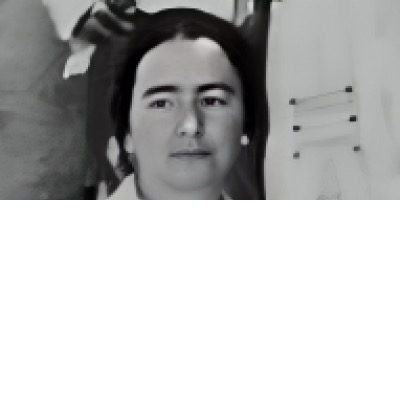
Sophie Halaby
صوفي حلبي
Born: Jerusalem, Ottoman Palestine
Domain: Visual Arts
Recognition: Regionally recognized
Biography
Sophie Halaby was born in Jerusalem around 1906 to a Palestinian-Christian father, Jiryes (George) Nicola Halaby, a dragoman attached to the Russian Orthodox Church, and a Russian mother, Olga Akimovna Khudobasheva, an Orthodox teacher. Raised in the cosmopolitan, multilingual world of late-Ottoman and early Mandate Jerusalem, she was educated at the English Girls' High School and grew up in a household where European culture, Orthodox faith, and Palestinian Arab life intersected — a formation that would shape both her cosmopolitan outlook and her lifelong attachment to the Jerusalem landscape. In 1929 Halaby was awarded a French government scholarship — arranged through the French consul in Jerusalem — to study art in Paris, making her one of the very first Arab women to travel to Europe specifically to train as an artist. She studied in Paris and undertook formative periods in Italy, including Florence, returning to Jerusalem in the early 1930s as a trained painter. Back home she taught art for years, including at the Schmidt Girls' School until the mid-1950s, working alongside her painter cousins Sonia and Louba Wahbe and helping seed a culture of women's artmaking in the city. Halaby is best known as a watercolorist of Jerusalem and its surrounding hills. Pointedly avoiding the religious monuments and orientalist panoramas that dominated foreign depictions of the city, she turned instead to the terraced terrain, the trees, and the wildflowers of the countryside — much of which has since vanished under urbanization. Often composed from a window or balcony and frequently empty of human figures, her landscapes carry a melancholic, atmospheric, almost dreamlike quality that reads, in retrospect, as an elegy for a disappearing Palestinian environment. The 1948 Nakba uprooted her as it did so many: she left West Jerusalem and resettled in the eastern part of the city, living with her sister Anastasia in Wadi al-Joz and later keeping a small shop where she sold handcrafts and her own watercolors. Younger artists such as Samia Halaby and Kamal Boullata recalled passing the shopfront daily to see what new work she had set out. In 1986 she took part — reluctantly — in the landmark "Tallat: Women's Art in Palestine" exhibition at the Hakawati Theatre in East Jerusalem. Sophie Halaby died in Jerusalem in the late 1990s, aged in her early nineties. Long under-recognized, the significance of her oeuvre was rediscovered toward the end of her life and after her death, and she is now counted among the pioneering modern artists of Palestine and among the first Palestinian women to make art a profession.
Why This Person Matters
As one of the first Palestinian women to train professionally as an artist in Europe, Sophie Halaby pioneered a homegrown, anti-orientalist vision of the Jerusalem landscape and opened the door for the women artists who followed.
Historical Context
Halaby's life spans the great ruptures of modern Palestinian history. Born in cosmopolitan late-Ottoman Jerusalem and coming of age under the British Mandate, she belonged to a generation of educated, often Christian, Jerusalem families for whom European study and Arab identity coexisted. Her 1929 scholarship to Paris placed her at the very start of Palestinian women's professional entry into the arts. The 1948 Nakba then severed her from West Jerusalem and forced her, like her whole milieu, into the diminished, divided city of the post-war years — a displacement that frames the quiet sense of loss running through her later landscapes.
Historical Context
- — Born in Jerusalem, Ottoman Palestine
- — The Nakba – Palestinian catastrophe and mass displacement
- — Six-Day War and occupation of West Bank and Gaza
- — Passed away at age 91
Selected Works
- Jerusalem and Landscape Watercolours — One of the first Palestinian women to study art formally in Europe, Halaby returned to paint Palestinian landscapes in a style bridging Post-Impressionism and local tradition — a pioneer whose works document the Palestine of the Mandate era.
Legacy & Influence
Though she worked quietly and was largely overlooked in her lifetime, Halaby is now recognized as a foundational figure in Palestinian modern art and a model for women entering the field. Her insistence on painting the ordinary terrain, trees, and wildflowers of Jerusalem — rather than its holy sites — preserved a vision of a landscape since transformed, giving her work documentary as well as aesthetic weight. Artists who grew up near her shop, notably Samia Halaby and Kamal Boullata, carried her example forward, and the rediscovery of her oeuvre, capped by the scholarly volume "Sophie Halaby in Jerusalem," has secured her place in the canon of Palestinian art history.
Topics & Themes
- Ottoman Era
- Jerusalem
References & Sources
- Sophie Halaby — Wikipedia — https://en.wikipedia.org/wiki/Sophie_Halaby
- Sophie Halaby — Jerusalem Story — https://www.jerusalemstory.com/en/bio/sophie-halaby
- Sophie Halaby — Palestinian Journeys / Interactive Encyclopedia — https://www.palquest.org/ar/biography/36545/%D8%B5%D9%88%D9%81%D9%8A-%D8%AD%D9%84%D8%A8%D9%8A