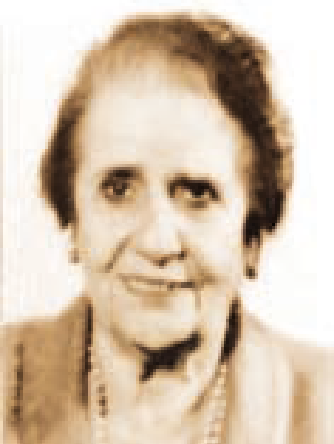
Matiel Mogannam
مَتيِل مُغنّم
Born: Mount Lebanon (Ottoman Lebanon), Ottoman Empire
Domain: Civil Society & Religion
Recognition: Regionally recognized
Biography
Matiel Mogannam (1899-1992) was a pioneering leader of the Palestinian Arab women's movement during the British Mandate and the author of the first English-language history of that movement, "The Arab Woman and the Palestine Problem" (London, 1937). She was born on 15 February 1899 into a Palestinian Christian family then living in Ottoman Lebanon; the family emigrated to New York City while she was still a child, and she grew up and was educated in the United States. There she married Mogannam Elias Mogannam, a lawyer originally from Ramallah who had trained at St. Lawrence University. In the mid-1920s the couple settled in Palestine, where Matiel quickly became active in the nationalist and women's spheres of Jerusalem society. She helped convene the preparatory meetings that produced the first Palestine Arab Women's Congress, held in Jerusalem on 26 October 1929 with roughly two hundred delegates from across the country, and she was chosen secretary of the Arab Women's Executive (AWE), the standing committee that grew out of it. Over the following years she served as secretary or officer of successive women's bodies, including the congresses of 1929 and 1932, the Eastern Women's Congress for the Defense of Palestine (Cairo, 1938), and the Arab Women's Union (1944), making her one of the most visible women in the public life of Mandate Palestine. Mogannam's enduring contribution is her 1937 book, the earliest book in English to narrate the emergence of the Arab and Palestinian women's movements and to set their demands within the wider national struggle against British rule and the Zionist project. She argued that the absence of a Palestinian national government itself obstructed the social reforms that would have allowed an effective women's movement to flourish. The manuscript was politically charged from the outset: in 1936 the London house Routledge & Sons rejected it as "propaganda" on the advice of the Zionist-leaning official Norman Bentwich, and it was finally issued by Herbert Joseph of London in 1937. A skilled writer and public speaker who also contributed articles to the Palestinian Arabic press, Mogannam combined feminist advocacy with uncompromising opposition to the Mandate and to Zionist settlement, and was on occasion likened in the press to a "Palestinian Gandhi" for her nonviolent nationalist activism. She and her husband settled in Ramallah in 1938 and lived through the upheavals that led to the 1948 Nakba and the loss of much of Arab Palestine. In 1980 Mogannam returned to the United States, settling in Falls Church, Virginia, where she lived out her final years. She died of congestive heart failure in 1992. Largely overshadowed for decades, she has since been recovered by scholars of Palestinian and Arab feminism as a foundational documentarian and organizer of the movement she helped to build.
Why This Person Matters
She organized and led the first Palestinian Arab women's movement of the Mandate era and wrote the earliest English-language history of it, securing both a place in national politics and a lasting documentary record for Palestinian women.
Historical Context
Mogannam came to political maturity in British Mandate Palestine of the late 1920s and 1930s, a period of mounting confrontation between the Palestinian Arab majority, the colonial administration, and an expanding Zionist settlement enterprise. The 1929 disturbances galvanized Palestinian society, and it was in their immediate aftermath that Arab women, hitherto largely confined to charitable work, entered organized national politics through the 1929 Women's Congress that Mogannam helped lead. Her activism spanned the Great Arab Revolt of 1936-1939 and continued into the 1940s, on the eve of the 1948 Nakba that would shatter the society her generation had mobilized to defend.
Historical Context
- — Born in Mount Lebanon (Ottoman Lebanon), Ottoman Empire
- — The Nakba – Palestinian catastrophe and mass displacement
- — Six-Day War and occupation of West Bank and Gaza
- — Passed away at age 93
Legacy & Influence
Mogannam's 1937 book endures as a primary source and a founding text for the historiography of Palestinian and Arab women's activism, repeatedly cited by historians of feminism and the Palestine question and recently revisited in scholarship on colonial-era publishing politics. As both organizer and chronicler, she established a model in which women's rights and national liberation were inseparable, and her recovery in contemporary feminist scholarship has restored her to a place among the founders of the Palestinian women's movement.
Topics & Themes
- Ottoman Era
References & Sources
- Matiel Mogannam — Wikipedia — https://en.wikipedia.org/wiki/Matiel_Mogannam
- Matiel Mogannam — Interactive Encyclopedia of the Palestine Question (Palquest) — https://www.palquest.org/en/biography/30018/matiel-mogannam
- Matiel Mogannam (1899-1992) — Institute for Palestine Studies — https://www.palestine-studies.org/en/node/1652996