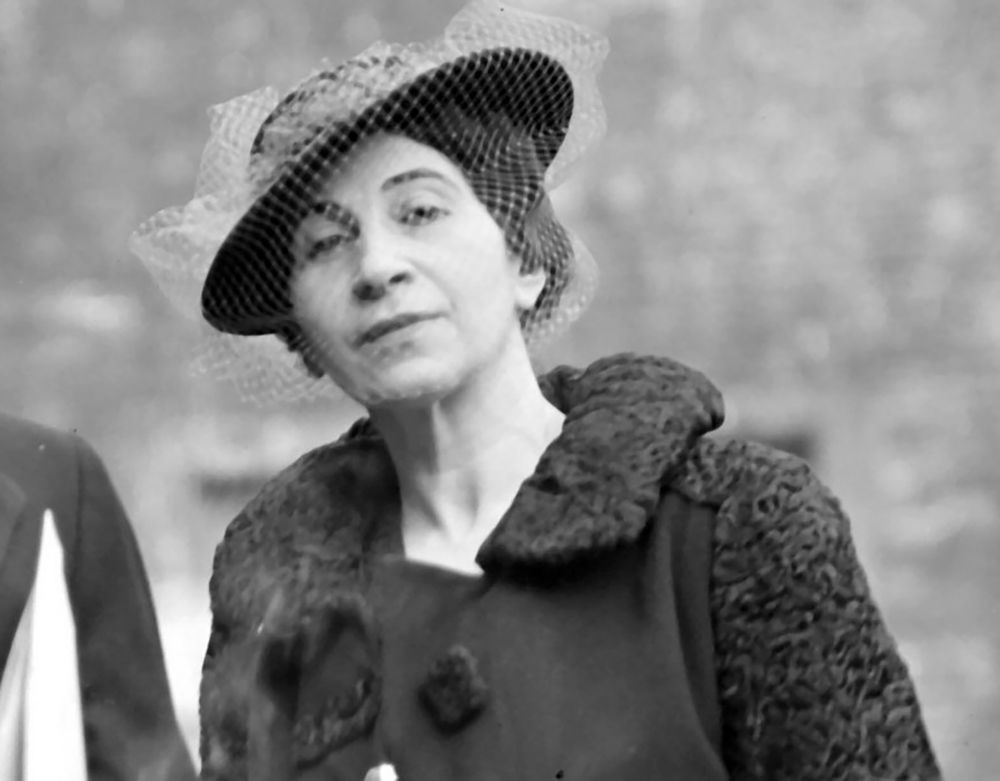
Katy Nimr Antonius
كاتي نمر أنطونيوس
Born: Cairo, Egypt
Domain: Civil Society & Religion
Recognition: Regionally recognized
Biography
Katy Nimr Antonius was born around the turn of the twentieth century into one of the most cosmopolitan Arab families of the Nahda (Arab Renaissance). Her father, Faris Nimr Pasha, was a celebrated Lebanese-Egyptian intellectual, journalist, and publisher who co-founded the influential periodical al-Muqtataf and the Cairo daily al-Muqattam; her mother came from a British-French-Austrian family settled in Alexandria. Raised in the privileged, multilingual society of Egypt's Levantine elite, Katy was at ease in Arabic, English, and French, an inheritance that would make her one of the most accomplished hostesses of the Arab world. In 1927 she married George Habib Antonius, the Alexandria-raised intellectual who became the foremost early historian of Arab nationalism through his landmark 1938 book The Arab Awakening. The couple settled in Jerusalem, and around 1930 moved into the stately Karm al-Mufti residence on the estate of Hajj Amin al-Husseini in Sheikh Jarrah. There Katy created what The Times would later call "the focal point of Jerusalem social life." Her salon drew British officials and officers, Arab notables, diplomats, journalists, and visiting writers; her parties—evening dress, Syrian cuisine, and dancing on a marble floor—became legendary across Mandate Palestine and the wider region. Katy was far more than a society hostess. She was a committed educator and humanitarian who, alongside George, helped establish and run Dar al-Awlad (the Home of the Children) in 1940, an institution in Jerusalem that sheltered and educated boys orphaned by the violence of the 1936–1939 Great Palestinian Revolt. She championed Arab women's education and welfare, and in February 1939 accompanied her husband to the London (St. James's) Conference on the future of Palestine, where she conveyed testimonies from Palestinian women about British repression. After George's early death in 1942, she sustained both the salon and her charitable work. Her standing made her a figure of political consequence and controversy. In 1946–1947 she conducted a widely noted relationship with General Evelyn Barker, commander of British forces in Palestine, a liaison that placed her at the intimate center of the Mandate's final, violent years. The 1948 Nakba shattered the world she had built: Sheikh Jarrah and the salon were lost, and the social order of Arab Jerusalem in which she had been a luminary was destroyed. In the aftermath Katy refused to abandon her humanitarian mission. In 1949 she reopened Dar al-Awlad and founded a restaurant she called "The Katakeet" (The Chicks), using its proceeds to finance the orphanage and the education of displaced children. She lived on into old age as one of the last living symbols of the lost cosmopolitan Jerusalem of the Mandate, and died in 1984. Her life was memorialized in obituaries in the British press and in the writing of her daughter, the novelist Soraya Antonius.
Why This Person Matters
She presided over Mandate Jerusalem's most influential Arab salon while building a lasting orphanage and education project, embodying both the cosmopolitan brilliance and the catastrophic loss of pre-Nakba Palestinian society.
Historical Context
Katy Antonius belonged to the Arab Christian intelligentsia that bridged the late-Ottoman Nahda and the British Mandate elite. Her father's Cairo press empire and her husband's pioneering Arab nationalist scholarship placed her at the crossroads of Egyptian, Levantine, and Palestinian high society. In Mandate Jerusalem (1920–1948), her Sheikh Jarrah salon functioned as a rare neutral ground where Arab notables and British administrators mingled, even as the Great Revolt and the road to partition pulled the two communities apart. The 1948 Nakba ended this world: her home and milieu were lost, and she joined the displaced Palestinian elite, redirecting her energies to relief and education amid catastrophe.
Historical Context
- — Born in Cairo, Egypt
- — The Nakba – Palestinian catastrophe and mass displacement
- — Six-Day War and occupation of West Bank and Gaza
- — Passed away at age 86
Legacy & Influence
Katy Antonius endures as an emblem of pre-Nakba Palestinian cosmopolitanism and of women's civic leadership in a male-dominated public sphere. Her Dar al-Awlad orphanage and post-1948 educational philanthropy left a concrete humanitarian legacy, while her salon survives in memoirs, obituaries, and histories as the defining image of cultivated Arab Jerusalem. Through her daughter, the novelist Soraya Antonius, and renewed scholarly interest in the Antonius family, her story has become a touchstone for understanding the social world, and the irreparable loss, of Mandate Palestine.
Topics & Themes
- Ottoman Era
References & Sources
- Katy Nimr Antonius: Jerusalem's Female Socialite and Hostess of Lavish Parties — https://www.jerusalemstory.com/en/bio/katy-nimr-antonius
- George Antonius — https://en.wikipedia.org/wiki/George_Antonius
- Pen Portraits from a Forgotten Middle East — https://foreignpolicy.com/2010/04/27/pen-portraits-from-a-forgotten-middle-east/