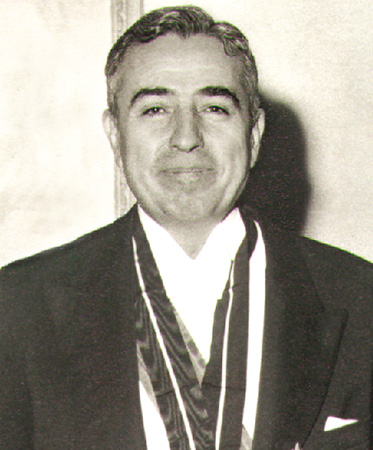
Anwar Nusseibeh
أنور نسيبة
Born: Jerusalem, Ottoman Palestine
Domain: Politics & Diplomacy
Recognition: Regionally recognized
Biography
Anwar Nusseibeh (1913–1986) was a Jerusalem statesman, jurist and Jordanian cabinet minister whose career spanned the last years of Ottoman rule, the British Mandate, the Nakba, and two decades of Israeli occupation of East Jerusalem. He was born in Jerusalem into the aristocratic Nuseibeh family, an ancient Arab lineage tracing its descent to Nusaybah bint Ka'b — the woman who defended the Prophet Muhammad at the Battle of Uhud — and entrusted since Saladin's reconquest of 1192 with custodianship of the keys to the Church of the Holy Sepulchre. Educated at the Rawdat al-Ma'arif al-Wataniyya School and the elite Arab College in Jerusalem, he was the first Palestinian Arab sent to an English public school, attending the Perse School before reading law at Queens' College, Cambridge, and being called to the bar at Gray's Inn in 1934. During the 1948 war Nusseibeh served as secretary of the Arab National Committee charged with organizing the defense of Jerusalem against the advancing Zionist forces. He lost a leg in combat — wounded while seeking to coordinate military support — and afterward briefly served as secretary to the cabinet of the All-Palestine Government in Gaza and helped lead Arab delegations in the armistice negotiations with Israel. The fall of Jerusalem and the dismemberment of his homeland marked him permanently and shaped the cautious realism of his later politics. After Jordan annexed the West Bank, Nusseibeh became one of the leading Palestinian figures in the Hashemite state. He was elected to the lower house of parliament in 1950 and held a succession of senior cabinet portfolios from 1952 onward — Defense, Education, Reconstruction and Development, and Interior — was appointed to the Senate in 1963, and served as Governor of Jerusalem from 1961. He was dismissed from the governorship for refusing to endorse arrangements legitimizing a border crossing with Israel, a characteristic act of principle. From 1965 to 1967 he served as Jordanian ambassador to the United Kingdom. A committed Arab nationalist, parliamentary democrat and advocate of a single-state solution in Palestine, Nusseibeh was firmly anti-fascist; he famously declined Michel Aflaq's invitation to join the Ba'ath, rejecting its authoritarianism. After the 1967 occupation of East Jerusalem he chose to remain in his native city, becoming one of the earliest Palestinians to engage in quiet contacts with Israelis while never recognizing the legitimacy of the occupation. From 1979 until his death he chaired the Jerusalem (East Jerusalem) Electric Company, whose contested concession became a symbolic front in the legal struggle over occupation. Nusseibeh died of cancer at his Jerusalem home on 22 November 1986, aged 73. His funeral drew thousands of mourners across the political spectrum, and he was buried at the gates of the Noble Sanctuary within the precincts of the Haram al-Sharif. He was the father of the philosopher and Al-Quds University president Sari Nusseibeh, who preserved and published his father's memoirs of the battle for Jerusalem.
Why This Person Matters
A principled Jerusalem statesman who defended the city in 1948, lost his leg in its battle, and served and embodied Palestinian Jerusalem under Ottoman, Mandate, Jordanian, and Israeli rule alike.
Historical Context
Nusseibeh's life maps almost exactly onto the central catastrophe of modern Palestinian history. Born under Ottoman rule and coming of age during the British Mandate as a member of Jerusalem's notable urban elite, he was thrust into the 1948 war as organizer of the city's defense — emerging maimed and dispossessed of the unified Arab Palestine he had known. Like much of the West Bank elite, he then operated within the Jordanian Hashemite framework that absorbed the West Bank after the Nakba, rising to the highest offices of state while Jerusalem remained a divided and contested city. The 1967 occupation again upended his world, casting him as a leading voice of an East Jerusalem population now living under Israeli rule.
Historical Context
- — Born in Jerusalem, Ottoman Palestine
- — The Nakba – Palestinian catastrophe and mass displacement
- — Six-Day War and occupation of West Bank and Gaza
- — Passed away at age 73
Legacy & Influence
Nusseibeh is remembered as a model of dignified, principled Palestinian leadership rooted in Jerusalem — a man who refused to legitimize occupation yet engaged pragmatically with adversaries, and whose custodial family lineage tied him to the deepest history of the city. His memoirs of the 1948 battle for Jerusalem remain a key primary source for historians, while his chairmanship of the Jerusalem Electric Company turned a utility into a landmark of the legal contest over East Jerusalem. His legacy also lives through his son Sari Nusseibeh, the philosopher, peace advocate, and president of Al-Quds University, extending the family's role in Palestinian intellectual and civic life into the present.
Topics & Themes
- Ottoman Era
- Jerusalem
References & Sources
- Anwar Nusseibeh — Wikipedia — https://en.wikipedia.org/wiki/Anwar_Nusseibeh
- Anwar Nusseibeh, Political Leaders (1913–1986) — Palestinian Journeys / Palquest — https://www.palquest.org/en/biography/16034/anwar-nusseibeh
- Anwar Nusseibeh Served Jerusalem under Three Occupiers — Jerusalem Story — https://www.jerusalemstory.com/en/bio/anwar-nusseibeh