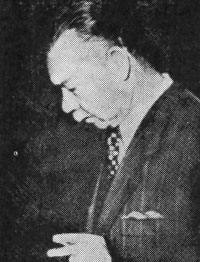
Ahmad Samih al-Khalidi
أحمد سامح الخالدي
Born: Jerusalem, Ottoman Palestine
Domain: Academia & Thought
Recognition: Regionally recognized
Biography
Ahmad Samih al-Khalidi was born in 1896 in Jerusalem into the prominent al-Khalidi family, one of the oldest and most distinguished scholarly households of the city, custodians of the celebrated Khalidi Library. The son of Hajj Raghib al-Khalidi, he came of age in the final decades of Ottoman rule. He enrolled at the Syrian Protestant College (later the American University of Beirut), intending to study history, but his studies were interrupted by conscription into the Ottoman army during the First World War in 1915. After the war and the establishment of British rule, al-Khalidi entered the field of education that would define his life. The Department of Education appointed him an inspector of education for the Jaffa and Gaza districts in 1919, and by 1923 he had risen to general inspector in Jerusalem; that same year he completed an MA at the American University of Beirut with a thesis on the education systems of late-Ottoman Palestine. In 1925 he was appointed principal of the Teachers College in Jerusalem, succeeding Khalil Totah, and was instrumental in having it renamed and elevated as the Arab College (al-Kulliyya al-Arabiyya), which under his leadership became the most prestigious Arab educational institution in Mandate Palestine and a training ground for the country's teaching and administrative elite. Al-Khalidi mattered because he was, more than any contemporary, the architect of modern Palestinian education and is widely remembered as the "father of modern education in Palestine." He championed critical thinking, science, and pedagogy grounded in psychology over rote memorization, and was reportedly the first educator in the Arab world to apply intelligence and aptitude tests to college applicants. He lectured on education and psychology, authored and translated numerous works on teaching, child development, and the history of education, and his textbooks were adopted across the Arab world, including in Iraq and Transjordan. His output and public service extended well beyond the lecture hall. He was appointed Deputy Director of Education for Palestine in 1946 while still leading the Arab College, and he founded and chaired the General Arab Orphan Committee, which established a model agricultural school for the sons of martyrs at Deir Amr near Jerusalem, the first institution of its kind in the Arab East. He married the pioneering Lebanese feminist and writer Anbara Salam in 1929, and their household in Jerusalem became a center of Arab intellectual life; their sons included the scientist Usama and the historian Tarif al-Khalidi. The Nakba of 1948 uprooted al-Khalidi from the city and institution he had served for a quarter-century. Before leaving, he placed the campus of the Arab College under Red Cross protection as it lay in a war zone, then went into exile in Lebanon. In Beirut he devoted his remaining years to writing, to scholarship, and to aiding Palestinian refugees and educating their displaced children. He died in Beirut in 1951.
Why This Person Matters
He built the Arab College of Jerusalem into the crown of Palestinian education and is remembered as the father of modern Palestinian pedagogy.
Historical Context
Al-Khalidi's career spanned the rupture from late-Ottoman to British Mandate Palestine. Conscripted into the Ottoman army in 1915, he rose through the Mandate's Department of Education as Palestinian Arabs sought to build national institutions under colonial rule and against the rising tide of Zionist settlement. The Arab College he led became a key site for cultivating a Palestinian educated class, until the 1948 Nakba scattered that class, including al-Khalidi himself, into exile across the Arab world.
Historical Context
- — Born in Jerusalem, Ottoman Palestine
- — The Nakba – Palestinian catastrophe and mass displacement
- — Six-Day War and occupation of West Bank and Gaza
- — Passed away at age 55
Legacy & Influence
Al-Khalidi's textbooks and pedagogical methods shaped education across the Arab world, and the graduates of his Arab College carried his standards into classrooms, universities, and administrations from Palestine to the Gulf. As an icon of pre-Nakba Palestinian achievement, he endures in Palestinian memory as the embodiment of a modern, self-determined national education, while his family line, including historian Tarif al-Khalidi, extended his intellectual legacy into the present.
Topics & Themes
- Ottoman Era
- Jerusalem
References & Sources
- Ahmad Samih al-Khalidi - Interactive Encyclopedia of the Palestine Question (palquest) — https://www.palquest.org/en/biography/9833/ahmad-samih-al-khalidi
- A Memorable Educator from Palestine: Ahmad Samih Al-Khalidi (1896-1951) — https://www.palestine-studies.org/en/node/1652784
- Ahmad Samih al-Khalidi - Arabic Wikipedia — https://ar.wikipedia.org/wiki/%D8%A3%D8%AD%D9%85%D8%AF_%D8%B3%D8%A7%D9%85%D8%AD_%D8%A7%D9%84%D8%AE%D8%A7%D9%84%D8%AF%D9%8A